
How to Effectively Mitigate Sheet Distortion in JUGAO Laser Cutting Operations
2026-09-30

Table of Contents
• Uncovering Root Sources of Plate Distortion During Laser Cutting
• Non‑Uniform Thermal Distribution Throughout Cutting Cycles
• High Heat Sensitivity of Thin‑Gauge Raw Materials
• Misconfigured Cutting Process Parameters
• Insufficient Plate Holding and Supporting Structures
• Practical Measures to Minimize Laser‑Induced Plate Distortion
• Step 1: Fine‑Tune Laser Power Output
• Step 2: Set Appropriate Travel Speed for Cutting Motion
• Step 3: Configure Optimized Focal Offset
• Step 4: Upgrade Plate Restraint and Supporting Mechanisms
• Step 5: Refine Cutting Route Arrangement
• Proven Operational Tips to Suppress Distortion for Thin Metal Plates
• Apply Micro‑Connection Tabs
• Pick Suitable Auxiliary Gas Varieties
• Guarantee Stable Incoming Material Performance
• Keep the Cutting Workbench Free of Residues
• Roles of JUGAO Equipment Servicing in Reducing Plate Distortion
• Examine Guide Rails and Bearing Assemblies
• Assess Nozzle Working Status
• Confirm Machine Calibration Accuracy
• Typical Operating Errors That Aggravate Plate Deformation
• Deploying Over‑High Power Output
• Neglecting Thickness Deviations of Raw Plates
• Prioritizing Cutting of Large Continuous Regions
• Frequently Asked Technical Questions
• Which factor triggers plate distortion most frequently in laser processing?
• Will boosted laser power amplify plate warping risk?
• What solutions work for distortion control on stainless‑steel workpieces?
• Final Summary
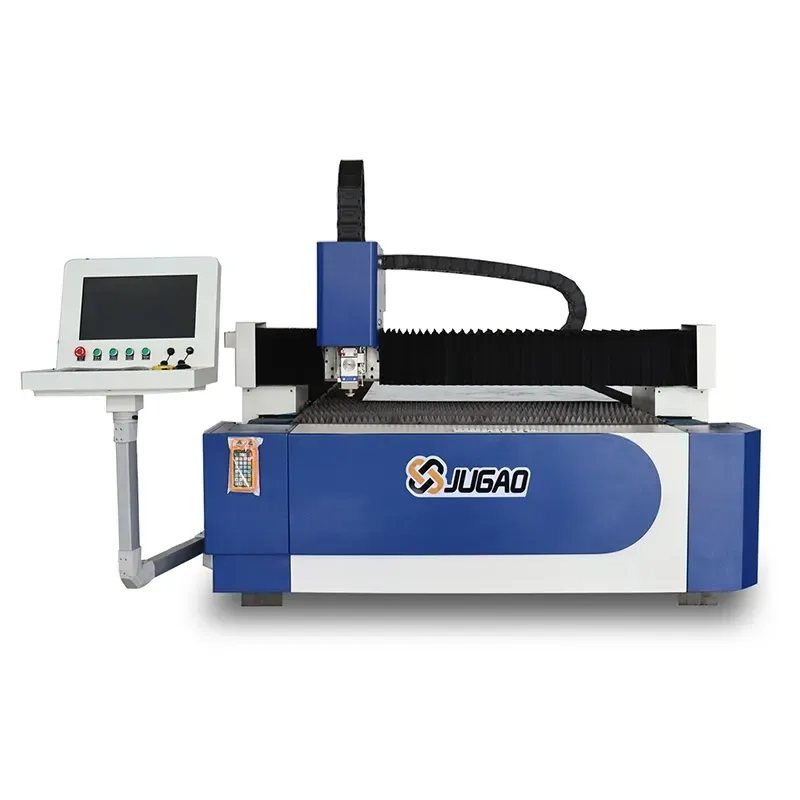
Plate distortion represents one of the most frequent manufacturing obstacles in metal sheet processing, especially while handling thin‑thickness workpieces on JUGAO laser cutters. If finished components tilt, twist or deform in the course of cutting, you are facing a widespread production headache. Distortion will downgrade dimensional precision, compromise assembly fitness and raise scrap volume. This article dissects key driving factors behind plate deformation and delivers practical mitigation approaches. Following these recommendations enables better cutting finish, lower reject ratios and more steady manufacturing outputs.
Uncovering Root Sources of Plate Distortion During Laser Cutting
To resolve deformation troubles, it is critical to locate underlying triggers first. Plate warping emerges when thermal stress surpasses the material’s capacity to retain flat geometry.
Non‑Uniform Thermal Distribution Throughout Cutting Cycles
Laser processing delivers concentrated local heat input. When certain zones of the plate heat far faster than surrounding areas, unequal thermal expansion takes place. While workpieces cool down afterwards, leftover internal stress bends and twists the metal sheet.
High Heat Sensitivity of Thin‑Gauge Raw Materials
Thin plates possess weaker structural rigidity compared with thick plates. Hence they are far more prone to thermally driven deformation under laser processing conditions.
Misconfigured Cutting Process Parameters
Over‑rated laser power, overly slow traverse velocity or improper focal settings inject surplus heat into workpieces, greatly lifting the probability of plate warping.
Insufficient Plate Holding and Supporting Structures
If raw plates cannot get adequate support from the cutting table, heated sections may sag or lift up during machining and result in permanent shape deformation.
Practical Measures to Minimize Laser‑Induced Plate Distortion
Step 1: Fine‑Tune Laser Power Output
Always start evaluation from laser power configuration. Excess power injects redundant thermal energy into workpieces.
Only adopt the minimal power level capable of delivering clean kerf quality. Reduced heat input relieves thermal stress and helps plates stay flat.
Step 2: Set Appropriate Travel Speed for Cutting Motion
Overly low cutting velocity builds up accumulated heat. Within the allowable parameter scope, raise cutting speed to shorten thermal exposure duration.
Carry out trial cuts so you can strike an ideal balance between surface finish and heat suppression.
Step 3: Configure Optimized Focal Offset
Incorrect focal parameters expand the heat‑affected zone and worsen component deformation.
Recheck focal position regularly and make adjustments corresponding to sheet thickness and processing objectives.
Step 4: Upgrade Plate Restraint and Supporting Mechanisms
Reliable supporting conditions are particularly vital for thin‑plate processing.
Make certain sheets sit fully flat on the cutting bed and deploy matched supporting fixtures to restrict workpiece displacement during cutting with JUGAO systems.
Step 5: Refine Cutting Route Arrangement
Reasonable part nesting and cutting sequence planning can remarkably lower thermal stress build‑up.
Avoid concentrating all cutting actions within a localized zone. Instead, disperse heat evenly over the whole plate by alternating processing positions.
Proven Operational Tips to Suppress Distortion for Thin Metal Plates
Apply Micro‑Connection Tabs
Micro‑joint tabs keep finished parts attached to the base plate throughout processing. This prevents component shifting and tilting caused by thermal stress.
Pick Suitable Auxiliary Gas Varieties
Auxiliary gas selection influences heat transfer performance and cutting efficiency.
For stainless steel and aluminum materials, nitrogen delivers cleaner cutting surfaces while bringing less thermal impact compared with oxygen.
Guarantee Stable Incoming Material Performance
Fluctuations in raw‑sheet properties will change deformation tendency.
Source plates from trusted suppliers and inspect flatness status before launching formal cutting tasks.
Keep the Cutting Workbench Free of Residues
Solidified slag and scattered debris create uneven supporting points underneath workpieces.
Frequent table cleaning ensures plates maintain horizontal placement in full processing cycles.
Roles of JUGAO Equipment Servicing in Reducing Plate Distortion
Examine Guide Rails and Bearing Assemblies
Worn‑out guide rails or bearing units trigger positioning deviations and mechanical vibration, further causing inconsistent cutting performance.
Assess Nozzle Working Status
Damaged or contaminated nozzles disrupt gas flow field and destabilize cutting conditions.
Inspect nozzles periodically and implement timely replacement upon detecting defects.
Confirm Machine Calibration Accuracy
Machine calibration quality directly decides cutting results.
Regularly verify focal‑height sensors, servo drive units and positioning precision to sustain stable running status for JUGAO laser cutting machines.
Typical Operating Errors That Aggravate Plate Deformation
Deploying Over‑High Power Output
Quite a few operators believe higher power brings higher productivity. On the contrary, excessive power increases heat input and accelerates workpiece deformation.
Neglecting Thickness Deviations of Raw Plates
Workpieces of different thickness demand separate parameter groups. Reusing identical settings across diverse materials will produce inconsistent processing outcomes.
Prioritizing Cutting of Large Continuous Regions
Cutting big areas ahead of small‑size features gathers massive heat and amplifies residual stress.
Adopt balanced cutting sequences to minimize shape distortion.
Frequently Asked Technical Questions
Which factor triggers plate distortion most frequently in laser processing?
Top contributing factors include excessive heat input, uneven thermal spread, inappropriate process parameters and inadequate workpiece supporting conditions.
Will boosted laser power amplify plate warping risk?
Yes. Excess laser power transfers more heat into metal materials, generating greater thermal expansion and residual stress that eventually cause plate distortion.
What solutions work for distortion control on stainless‑steel workpieces?
Adopt well‑tuned processing parameters, select nitrogen as auxiliary gas, set proper focal points and implement distributed cutting paths to ease heat accumulation and suppress deformation.
Final Summary
Controlling laser‑cutting plate distortion requires joint efforts of reasonable parameter matching, effective heat management, qualified raw materials and routine JUGAO equipment maintenance. By tuning laser power, adjusting cutting velocity, optimizing plate supporting structures and adopting intelligent cutting trajectories, you can substantially lower thermal deformation and upgrade part quality.
Persistent condition monitoring and preventive maintenance secure stable cutting performance while cutting down manufacturing expenses. If you keep suffering severe distortion problems or require support for process optimization, feel free to reach our technical team for professional consultation and guidance.
Contact Us