
What are the functions of welding robots?
2026-05-21

Welding robots can be applied to engineering machinery manufacturing, municipal construction, containers, heat exchangers, hardware, and welding. As automated robots, they improve the automation and intelligence levels of various fields such as shipbuilding. Intelligent, information-based, and technologically advanced products can improve welding efficiency and stabilize welding quality.
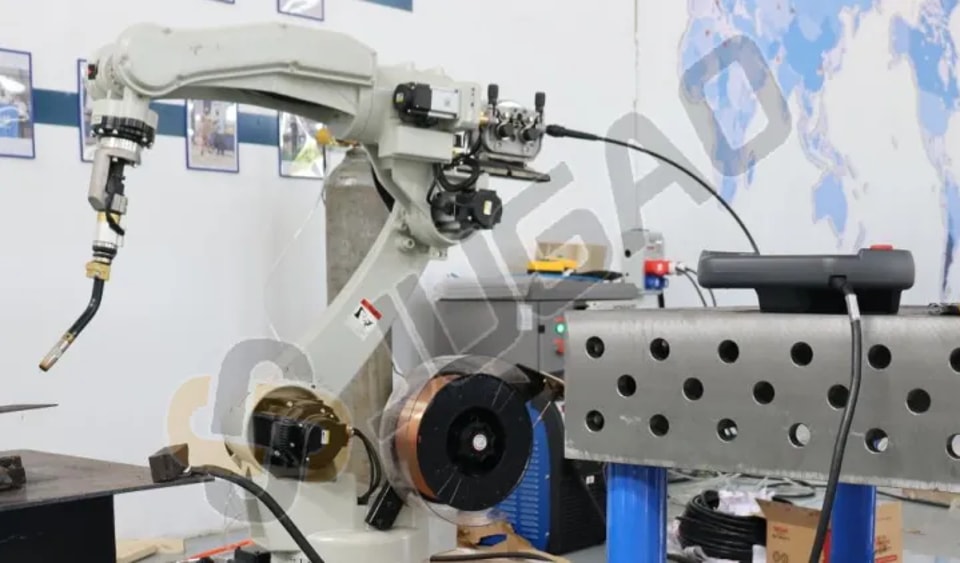
Functions of Welding Robots
1. Automatic Weld Seam Search Function
The automatic weld seam search function of welding robots can improve welding accuracy. The specifications of welded parts and weld seams vary depending on the work area. The automatic weld seam search function is divided into arc tracking and laser tracking. Arc tracking can be tested at any position of the weld seam. Even if the welding position deviates, it is easy to test. Laser tracking is widely used to track thin plate weld seams, especially splicing weld seams.
2. Memory Function
Welding robots will store welding actions to a certain extent and can recall saved welding data during the welding process of the parts, with high repeatability. Users can directly use parameters in daily operations. It is worth noting that in order to prevent data loss from affecting subsequent work, data needs to be backed up in a timely manner during daily operations.
3. Arc Monitoring Function
The welding robot, equipped with multiple welding parameters, features an arc monitoring function that monitors the welding current in real time. If any issues arise with parameters such as welding voltage, welding torch position, arc ignition and cessation, or wire feed speed, alarm signals will be issued promptly. The operator can then adjust these parameters via the teaching pendant.
4. Self-Protection Function
During welding operations, the automatic welding machine may be damaged due to human error or equipment malfunction. When encountering a hazard, the self-protection function can promptly stop the welding operation to protect the operator from injury.
5. Synchronization and Coordination Function
Welding robots and auxiliary welding equipment often struggle to complete complex welds. The operator operates the auxiliary equipment in the teaching pendant to synchronize the welding robot's movement with the external axis, enabling the completion of complex welds.
6. Multi-Layer, Multi-Pass Welding Function
For welding thicker workpieces, a multi-layer welding path method is typically used. During the welding process, if the welding path stored by the sensor slightly deviates, multi-layer welding can be repeated. The multi-layer welding function only requires one repetition; the remaining welding paths can be welded automatically.
7. Dustproof Function
The welding robot has an IP54 dustproof rating, which can isolate fumes and prevent welding difficulties.
Contact Us