 Get a quote
Resources
Angle Calculation – How to Calculate the Bending Angle for Large Arc Bends

Angle Calculation – How Many Bends Are Needed for a Large Arc and How to Calculate the Bending Angle
Method 1
How to bend an arc? (Without a dedicated die)
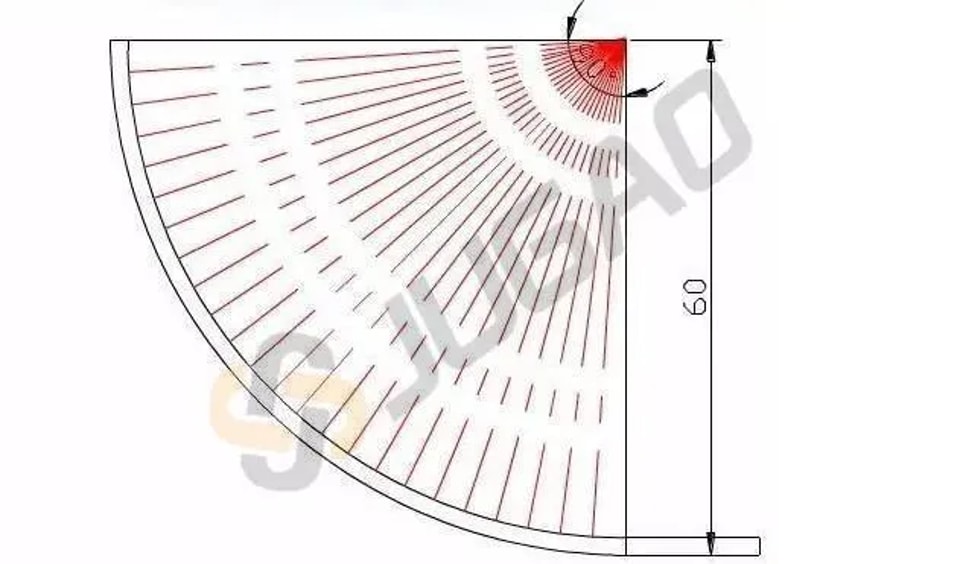
As shown above:
Sheet thickness T = 2 mm, central angle = 90°
1. Calculate the arc length:
Arc Length L = 90° × π ÷ 180° × Neutral Axis Radius R59 = 92.63 mm
2. Select the bending tooling:
Use a straight blade for the upper die and an 8V lower die (When bending an arc, choose the minimum allowable V-width, typically 4T to 6T).
3. Calculate the feed per bend:
Feed per Bend = Half of the selected lower die's V-width.
4. Calculate the number of bends required:
Number of Bends = Arc Length L (92.63 mm) ÷ (V-width / 2 = 4 mm) ≈ 23 bends.
5. Calculate the positioning dimension for each bend:
After calculating the first bend's positioning dimension, decrease each subsequent bend by 4 mm (Bending sequence should be planned from the inside outward).
6. Finally, calculate the bending angle for each bend:
This is based on standard trigonometric formulas.
7. Test bending:
After verifying the calculations, perform test bends on scrap material to confirm the angle before proceeding with the actual part.
Method 2
Consider the following diagram:
Sheet thickness: 2 mm
Bend angle: 120°
External bend radius: 30 mm
Neutral axis radius: 29 mm
For arc bending, the developed length is based on the neutral axis arc length. Therefore, the number of bends and the angle per bend should also be calculated using the neutral axis arc length.
The neutral axis is located at a distance of half the sheet thickness from the inner surface.
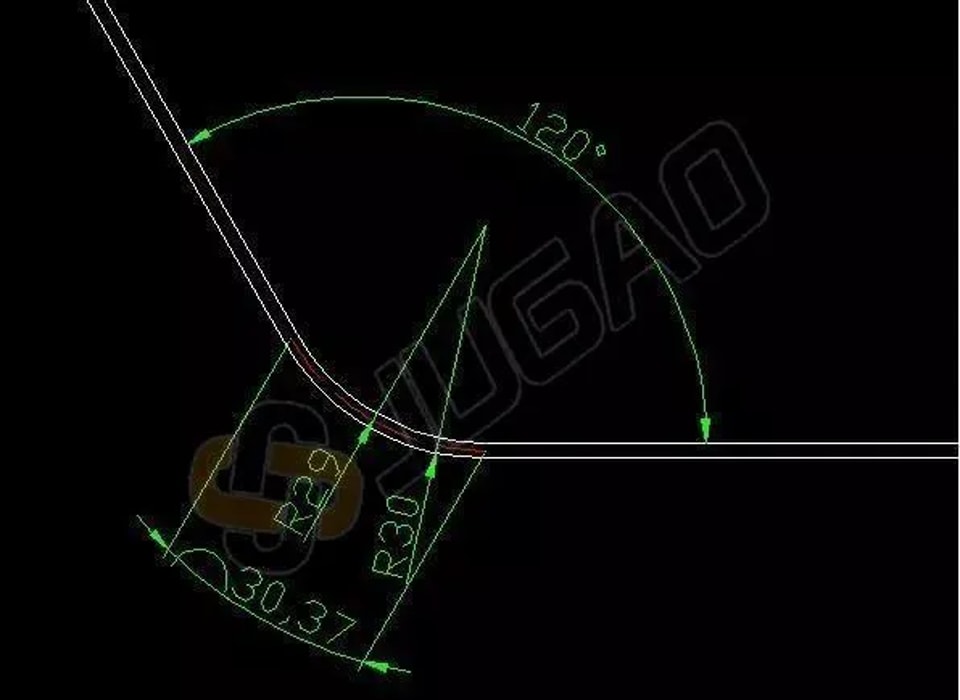
For the arc bend shown above, how many bends are needed and what should the bending angle be for each?
If the feed per bend is 2 mm:
l Number of Bends = Arc Length / 2 mm = 30.37 / 2 ≈ 15 bends
l Bending Angle per Bend
= 180 - { (2 / Arc Length) × (180 - Total Bend Angle) }
= 180 - { (2 / 30.37) × 60 }
= 176°
If the arc length cannot be measured directly during operation, the bending angle can also be calculated using the following formula:
Bending Angle per Bend = 180 - { (2 / (π × Neutral Axis Radius)) × 180 }
= 180 - { (2 / (3.14 × 29)) × 180 }
= 176°
To use a different feed per bend (e.g., 3 mm), simply replace the value '2' in the formulas above with the desired feed value.
These formulas provide theoretical values. In practice, adjustments should be made based on test results using the calculated values as a starting point.
Related
Keep
reading.
 Comparison of Laser Welding Results and Application Scenarios Across Different Materials
 How to Choose Between Air-Cooled and Water-Cooled Laser Welding Systems
 Understanding Punching Machines: Principles, Types, and Selection
 How can one effectively follow the installation guidelines for a pipe-bending machine?
 For which types of products is an automatic wire-feeding laser welding machine suitable?
 What Are the Latest Punching Machine Trends and Technological Breakthroughs?
 What Triggers Punching Machine Noise and How Can You Quieten It?
 What factors influence the replacement cycle of wear parts in a pipe-bending machine?
 Beyond price, what key parameters should you consider when purchasing welding equipment?
 4 Common Methods for Inspecting Weld Quality
 Selecting the Top Punching Machines for Small Workshops & Heavy Industry
 How do you set the welding path for a robotic laser welding machine? Can it perform precise welding on complex workpieces?
Engineering review
Send a drawing.
Get an engineer.
Standard selections answered within 4 hours. Parts outside the rules get a written process review within 24 hours.
- Part drawing: DXF, DWG, STEP or PDF
- Material and thickness
- Longest bend or cut length
- Yearly volume
Write to info@ntjugao.com or message the factory on WhatsApp +86 132 2211 1178.
Drawings (DXF, DWG, STEP, PDF): attach them to an email to info@ntjugao.com, quoting your name.