
What New Operators Need to Learn About JUGAO Handheld Laser Welders
2026-06-30

Table of Contents
1. Core Laser Welding Working Logic
2. Practical Operation Case: 0.5mm Stainless Steel Right-Angle Overlap Welding
3. Step-by-Step Parameter Optimization
4. Weld Appearance Contrast & Effect Analysis
5. Summary & Operation Suggestions
6. Reference Operation Video
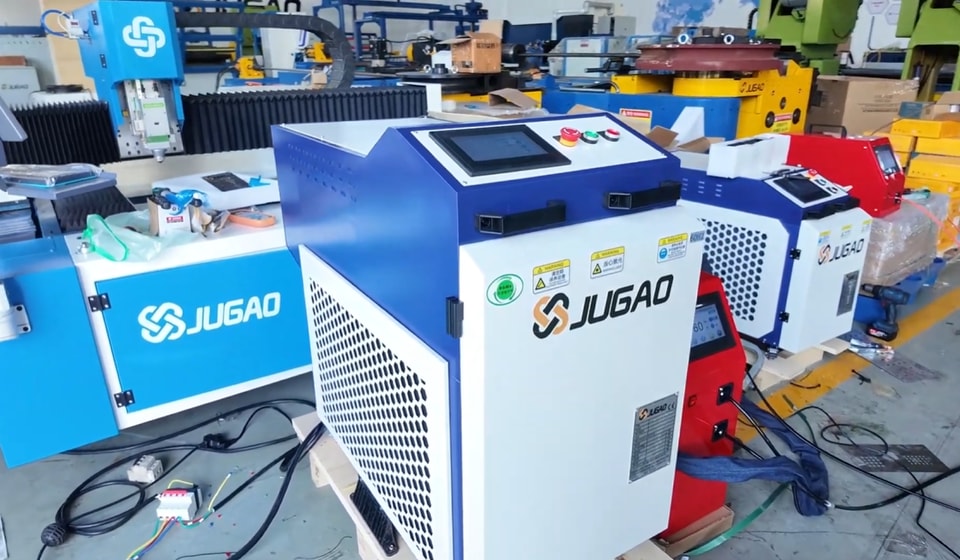
Are you confused when operating your first portable laser welding equipment? This targeted tutorial tailored for JUGAO handheld laser welders sorts out all core foundational knowledge for new operators, helping you quickly master operation skills and avoid frequent beginner errors.
To stably operate a JUGAO handheld laser welder, operators must first get familiar with each functional component of the machine, match suitable process parameters according to the base metal’s material and thickness, and conduct trial welding on waste metal scraps before formal processing. Complete protective safety equipment is a mandatory prerequisite for all welding operations. To obtain uniform, defect-free weld beads, operators need to maintain a stable welding angle, uniform moving speed and smooth hand movement. Following this complete operation workflow can guarantee safe processing and high-precision welding forming.
This tutorial focuses on the operation guide of JUGAO portable laser welding equipment. Reasonable matching and fine adjustment of laser parameters are the core premise to produce high-quality welds. This article will systematically explain core welding logic, attach a complete real welding case, and share practical parameter tuning skills for JUGAO laser welders.
Core Laser Welding Working Logic
1. Matching Rule Between Base Metal Thickness & Filler Wire Diameter
• Thicker workpieces require thicker matching filler wires.
• Thick plates paired with thick wires demand higher laser power output.
• Filler wire feeding speed needs to be slowed down when welding thick metal sheets.
2. Laser Power Output Regulation Rules
• Low power output creates bright silver-white weld bead surfaces.
• Excessively high power will darken the weld seam to dark gray or black, which means the metal only forms a single-sided melting layer and lacks penetration.
3. Selection Standard of Filler Wire Diameter
• The filler wire diameter cannot exceed the thickness of the welded base metal plate.
• Overly thick filler wires will lead to uneven filling and insufficient fullness of the weld bead.
• Thin filler wires narrow the laser scanning coverage width of the welding track.
4. Adaptation Adjustment for Different Laser Equipment Brands & Materials
• Different brand laser equipment including JUGAO series needs minor targeted parameter trimming.
• Welding aluminum alloy materials requires a 20%–30% power boost compared to stainless steel of the same thickness.
• Operators need to adjust the laser focus position properly according to the specific model of JUGAO handheld welder.
Reference Parameter Table for JUGAO Handheld Laser Welding Equipment
Workpiece Material | Plate Thickness (mm) | Scanning Speed | Scanning Width (mm) | Peak Laser Power (W) | Duty Cycle | Pulse Frequency | Wire Feed Speed (cm/S) | Matching Welding Filler Wire |
Carbon Steel | 1 | 300 | 3 | 350 | 100 | 2000 | 60 | 1.0mm carbon steel wire |
2 | 300 | 3 | 700 | 100 | 2000 | 60 | 1.2mm carbon steel wire | |
3 | 300 | 3 | 1100 | 100 | 2000 | 60 | 1.2mm carbon steel wire | |
4 | 300 | 3 | 1500 | 100 | 2000 | 60 | 1.6mm carbon steel wire | |
5 | 220 | 3 | 1800 | 100 | 2000 | 50 | 1.6mm carbon steel wire | |
6 | 220 | 3 | 2200 | 100 | 2000 | 50 | 1.6mm carbon steel wire | |
8 | 220 | 3 | 3000 | 100 | 2000 | 40 | 2.0mm carbon steel wire | |
Aluminum Alloy | 1 | 300 | 3 | 500 | 100 | 2000 | 60 | ER5356 1.0mm aluminum wire |
2 | 300 | 3 | 800 | 100 | 2000 | 60 | ER5356 1.2mm aluminum wire | |
3 | 300 | 3 | 1400 | 100 | 2000 | 60 | ER5356 1.2mm aluminum wire | |
4 | 300 | 3 | 1800 | 100 | 2000 | 60 | ER5356 1.6mm aluminum wire | |
5 | 220 | 3 | 2000 | 100 | 2000 | 50 | ER5356 1.6mm aluminum wire | |
6 | — | — | — | — | — | — | — | |
8 | — | — | — | — | — | — | — | |
Stainless Steel | 0.5 | 300 | 2 | 260 | 100 | 2000 | 80 | ER304 0.8mm stainless steel wire |
0.8 | 300 | 2 | 300 | 100 | 2000 | 80 | ER304 0.8mm stainless steel wire | |
1 | 300 | 2 | 350 | 100 | 2000 | 60 | ER304 1.0mm stainless steel wire | |
2 | 300 | 3 | 700 | 100 | 2000 | 60 | ER304 1.0mm stainless steel wire | |
3 | 300 | 3 | 1100 | 100 | 2000 | 60 | ER304 1.2mm stainless steel wire | |
4 | 300 | 3 | 1500 | 100 | 2000 | 60 | ER304 1.2mm stainless steel wire | |
5 | 220 | 3 | 1800 | 100 | 2000 | 50 | ER304 1.6mm stainless steel wire | |
6 | 220 | 3 | 2200 | 100 | 2000 | 50 | ER304 1.6mm stainless steel wire | |
8 | 220 | 3 | 3000 | 100 | 2000 | 40 | ER304 2.0mm stainless steel wire |
Note: All data in the table serves as standard reference parameters for JUGAO handheld laser welders; operators need to adjust values flexibly based on actual on-site welding conditions.
Practical Operation Case: 0.5mm Stainless Steel Right-Angle Overlap Welding
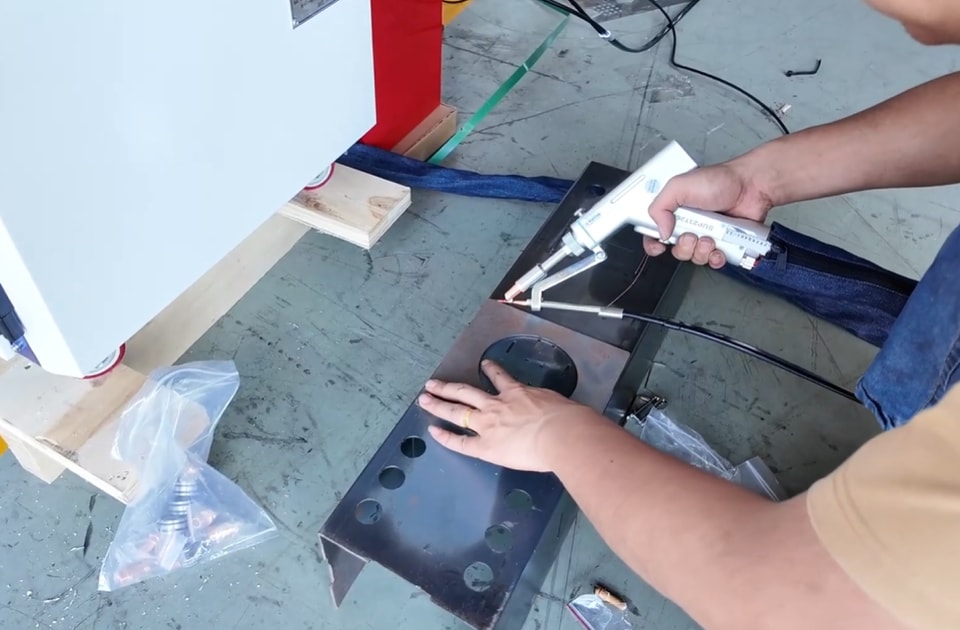
Initial Parameter Configuration Trial
• Filler wire selected: 0.8mm ER304 stainless steel welding wire
• Laser scanning moving speed: 350
• Laser scanning width: 2
• Peak power output: 350W
• Duty cycle ratio: 100
• Pulse frequency: 2000Hz
• Welding result feedback: The laser penetration force is too strong, completely piercing the thin 0.5mm stainless steel sheet, and the workpiece suffers severe thermal deformation after welding.
First Round Parameter Optimization
• Adjustment content: Lower peak laser power down to 260W
• Welding effect improvement: The overall thermal deformation of the workpiece is obviously reduced, yet the start position of each welding track still has burn-through defects easily.
Second Round Parameter Optimization
• Adjustment content: Further cut peak power to 200W; expand laser scanning width from 2 to 3
• Welding effect improvement: Workpiece thermal deformation is greatly controlled, and the expanded scanning width makes the weld bead forming smoother and more uniform with fewer defects.
Weld Appearance Contrast & Effect Analysis
1. Sample 1: Weld forming state under the initial unoptimized parameter group
2. Sample 2: Weld forming state after expanding scanning width to 3 with lowered power
Summary & Operation Suggestions
Precise fine-tuning of laser welding parameters is the decisive factor to obtain ideal weld forming quality. All process data and matching rules in this article are universal reference standards for JUGAO handheld laser welders. In actual production, operators should make targeted adjustments according to the workpiece material, thickness, welding joint type and production requirements. Wish every operator smooth and high-quality welding processing!
Reference Operation Video
A complete real-machine operation demonstration video of JUGAO handheld laser welding is available for operators to learn the whole set of tuning and welding operations visually.
Contact Us