
How to Evaluate a Press Brake Manufacturer: A Buyer’s Evidence Checklist
2026-09-29


Press brake procurement
How to evaluate a press brake manufacturer
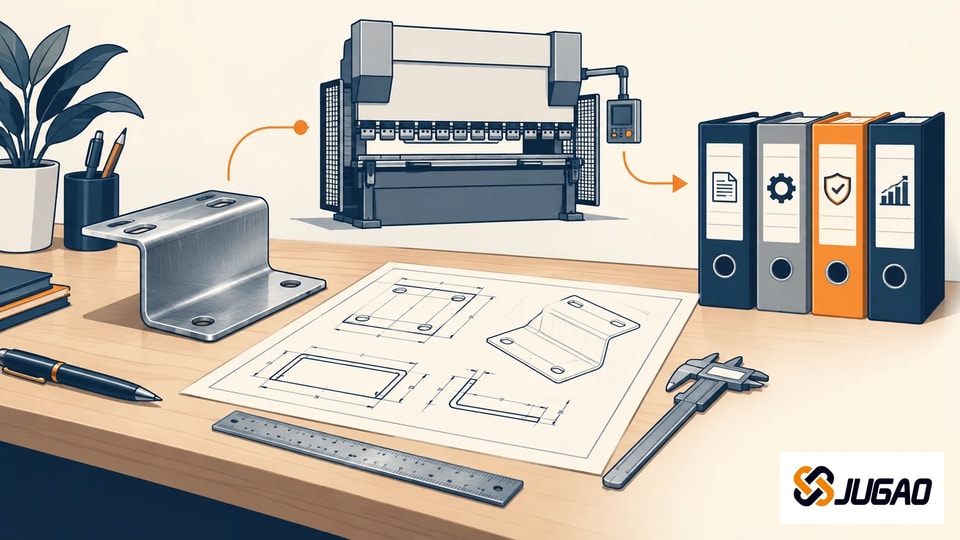
Evaluate a press brake manufacturer by tracing each important claim to four things: the exact machine configuration, a dated piece of evidence, a written order requirement, and an agreed acceptance check. A product page or nominal tonnage alone does not define what will be delivered or how it will be supported.
Do not rank suppliers by the loudest promise or the lowest total. Build a traceable chain from Claim to Evidence, Evidence to Contract, and Contract to Acceptance.
01 / The four-part evidence chain
02 / Why isn’t a machine page the same as an order?
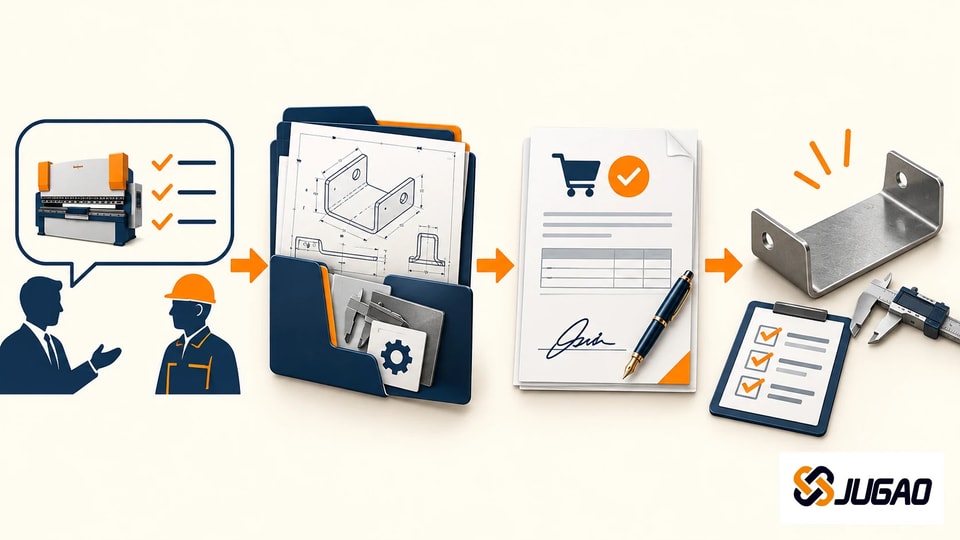
A public product page is useful for narrowing the field. A quotation translates a buyer’s request into a dated, project-specific offer. A signed configuration locks what will be delivered. An acceptance record documents whether that particular machine met the agreed test. Those are four different documents with four different jobs.
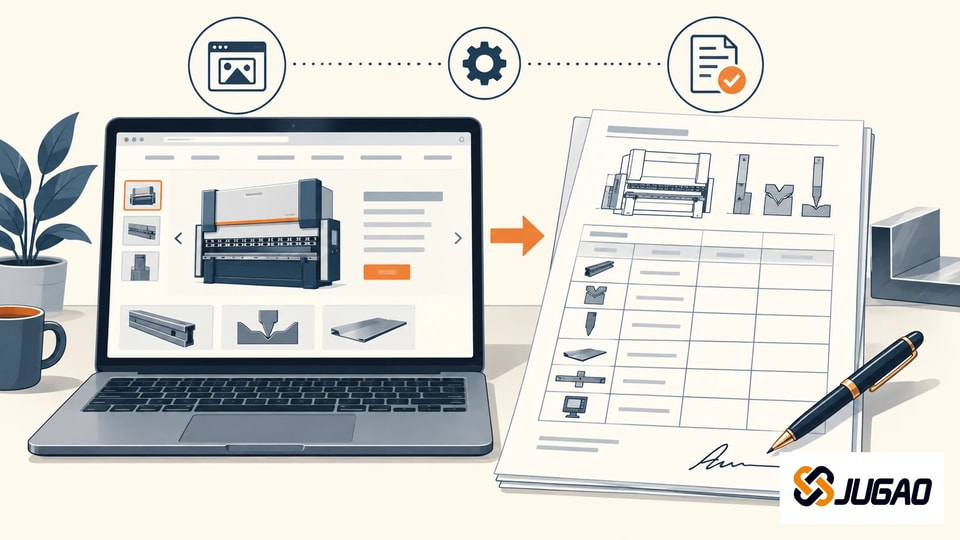
Keep the evidence status visible. If a specification appears only in a brochure, label it generic. If it is in the signed configuration for the identified machine, label it order-specific. “Missing” means the supplier has not provided it. “Unresolved” means the parties have different versions or interpretations. This distinction protects both sides: buyers avoid treating marketing fields as guarantees, and suppliers avoid being held to an assumption that was never in scope.
Put a source date, document version and responsible contact beside each material claim so a later reviewer can reconstruct what was known when quotes were compared.
- Published spec fields for a model family
- No buyer, no date, no scope of supply
- Useful only to shortlist candidates
- Not order-specific unless incorporated into the signed contract
- One machine, dated version, named parties
- Axis list, tooling, safety and voltage fixed
- Inclusions, options and exclusions written out
- This is what the supplier must deliver
03 / Who owns each hand-off?
“Manufacturer,” “OEM,” “dealer” and “export seller” describe different possible roles. The label is less important than the written hand-off. Ask the counterparty to identify who makes the machine, who signs the contract and invoice, who owns the warranty, who sends the installer, who trains operators and who supplies parts when a production line is down.

A role is not proven by a logo, product title or “factory-direct” phrase. The contract should say who is accountable at each hand-off. If the sales contact, contract party, invoice entity and warranty provider differ, record those relationships instead of assuming one automatically answers for another.
04 / What belongs in a configuration matrix?
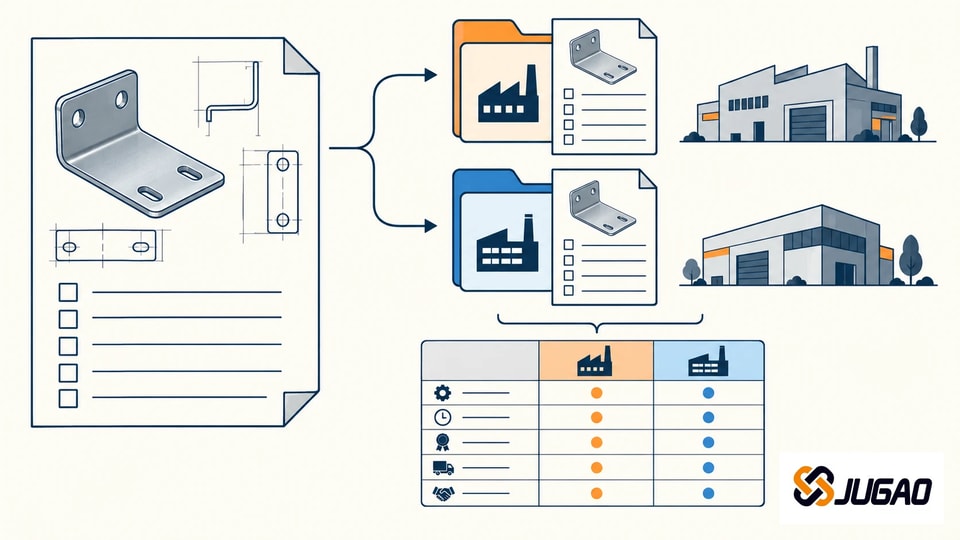
Send every supplier the same short RFQ: representative drawings, material and thickness range, expected work rhythm, destination and electrical assumptions. Protect sensitive drawings with redaction or an agreed NDA process. Keep a dated copy of the shared request and attach each reply to it.
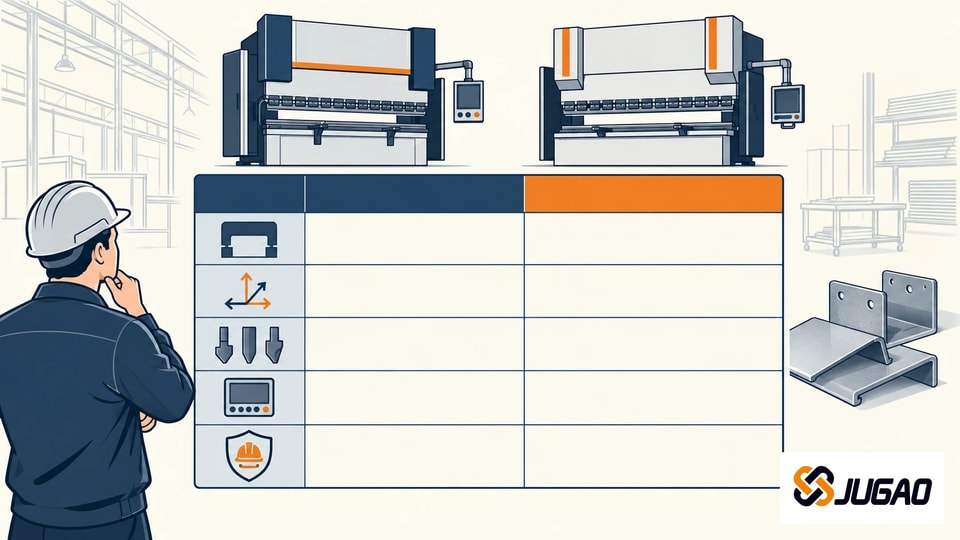
Freeze the question before collecting answers. If one supplier receives only a thickness range while another receives a finished-part drawing, the comparison measures the brief, not the machine. Separate standard, optional, buyer-supplied and excluded items: a controller may omit software, a tool interface may exclude segmented tools, and an installation visit may exclude unloading or electrical connection.
| Buyer question | Evidence to request | Order / acceptance record | Watch for |
|---|---|---|---|
| Who is the counterparty? | Legal seller, maker/OEM/dealer role, contract and invoice entity | Contract party, manufacturing role and warranty owner | Roles shift between calls, quote and contract |
| What is the exact machine? | Model, serial when assigned, nominal pressure, bed and dimensional fields | Dated, approved configuration annex | Only a family name or generic brochure |
| What is configured? | Controller model, axis-by-axis list, backgauge, drives and options | Axes and option schedule | Controller name treated as axis proof |
| What tooling is included? | Interface, segments, tool identifiers and rated loads | Tool list; included, optional and buyer-supplied lines | “Standard tooling” with no list |
| Can it run the part? | Project-specific calculation, material and process assumptions | Part boundary, tools and change/re-quote trigger | Blanket “yes” without conditions |
| Can it be installed? | Destination voltage/frequency, access, lifting, documents and safety file | Delivery, unloading, installation, training and acceptance scope | Freight, crane or commissioning left silent |
| Who supports it? | Warranty scope, exclusions, service route and parts list | Start date, cost allocation and escalation path | “Fast service” without a mechanism |
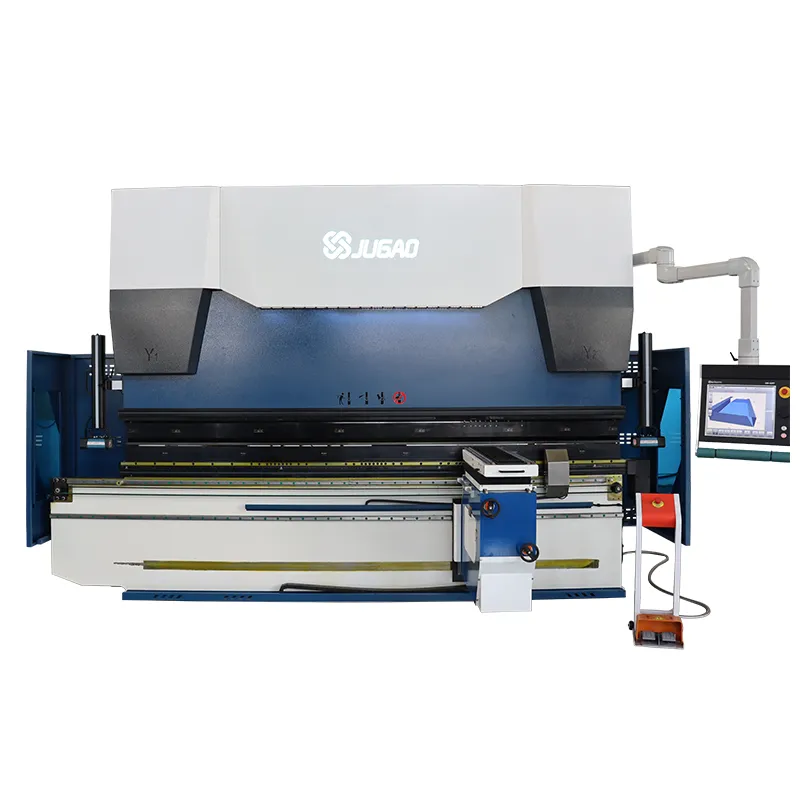
The JUGAO DA-66T product route is another reminder to check scope rather than infer it from a title. For the selected machine, request the actual axis list, backgauge arrangement, drives, software options and included tooling in the order schedule.
05 / How do you test a technical claim?
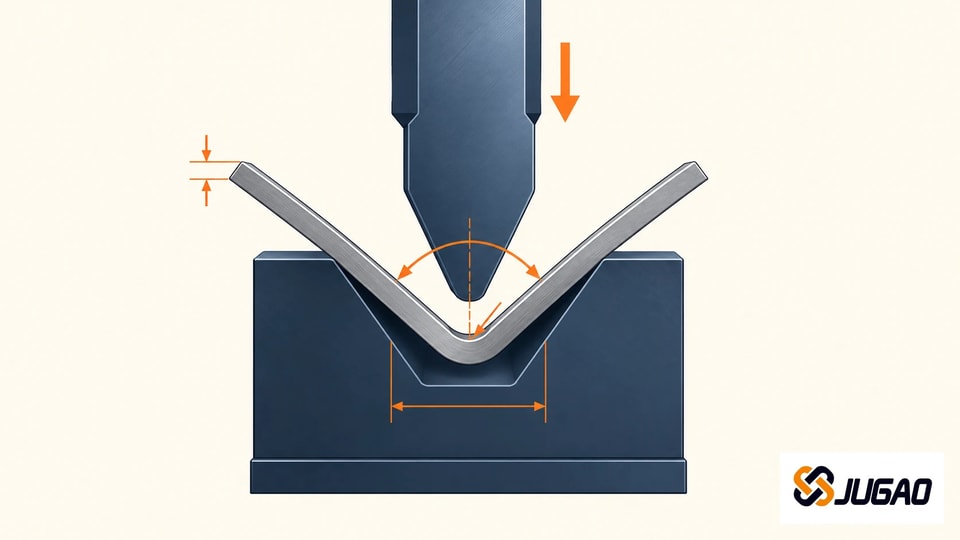
Start with a representative part and write down the assumptions: material grade and strength, thickness, bend length, angle, inside radius, tooling, sequence and expected production rhythm. Ask for a written calculation and tooling ratings tied to those inputs. The useful question is not “How many tons?” but “Under which stated conditions, with which tools, will this part be made and measured?”
WILA’s air-bending explanation describes how V-opening affects radius, force, minimum flange and the resulting workpiece. Its 6–8× plate-thickness range is an initial rule of thumb for steel air bending, not a universal rule and not a substitute for a project calculation.
The Delem DA-66T page describes controller functions. That controller capability does not prove the axis count, servo arrangement, software options, machine model or safety compliance of a particular JUGAO quotation. Put those order-specific details in the schedule.
- Describes what the control system can do
- 2D programming, bend sequencing, collision checks
- Shared across many machine sizes
- Does not fix the machine in front of you
- Y1/Y2 ram, plus X, R, Z1/Z2 backgauge as quoted
- Drive type and servo arrangement per axis
- Software options and licences listed by name
- Safety configuration confirmed for this serial
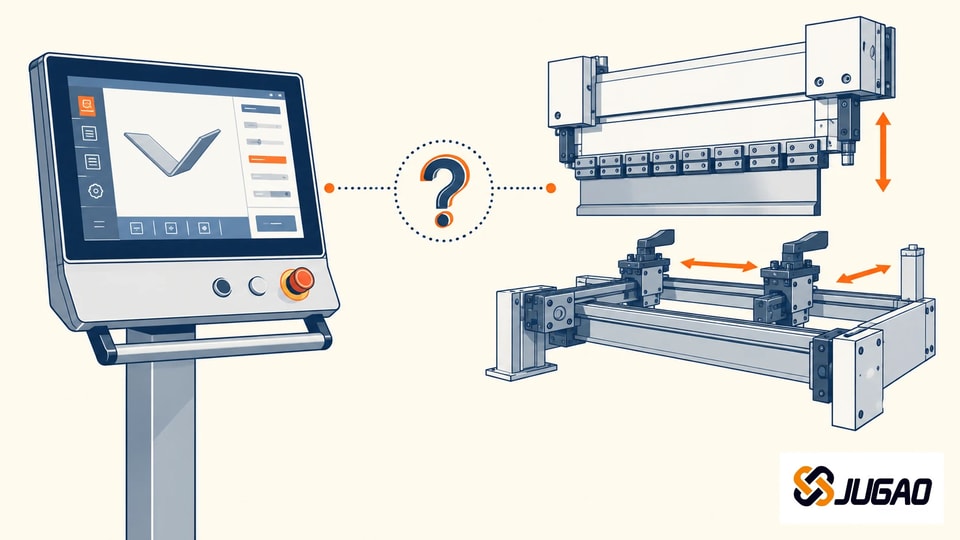
Ask for calculation inputs, not just the conclusion: material and strength assumptions, bend length, die opening, radius, bend count and permitted tool load. Record representative parts, exclusions and what triggers a re-quote. This is a supplier-evidence check, not a repeat of a geometry or tonnage tutorial.
06 / What should a FAT record contain?
A factory acceptance test should identify the machine and signed configuration, then use an agreed representative sample. Before the test, define the measurement method, tolerance, instruments, surface or angle criteria, defect owner and re-test condition. Use actual agreed observations; do not substitute a stock video or an unnumbered photo for a result tied to the tested machine.
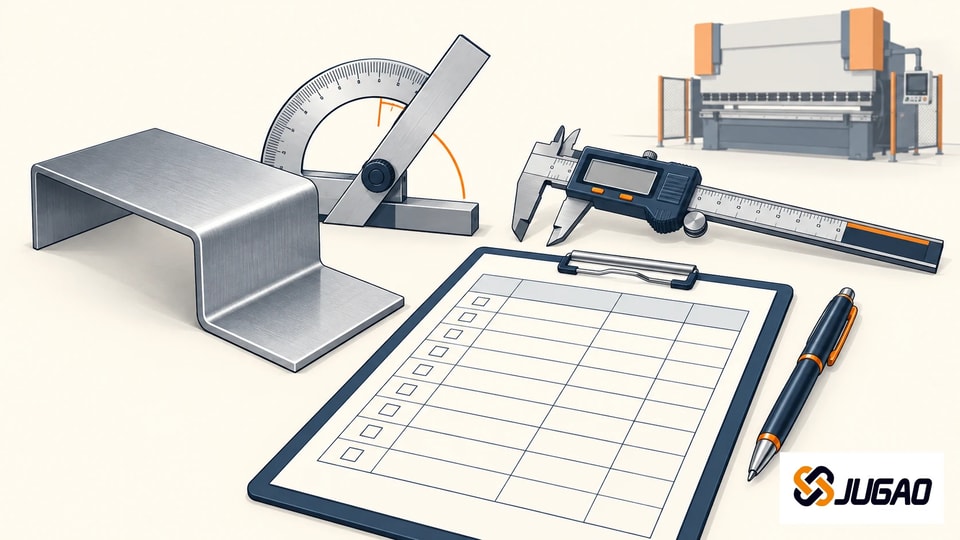
If a result falls outside tolerance, the record should name the defect, responsible owner, due date, containment, re-test condition and final sign-off. Before the test starts, agree who can sign, how an unresolved measurement is escalated and whether final acceptance waits for the re-test. A blank form makes these decisions visible while both sides can still negotiate them.
07 / How do you close the export and service loop?
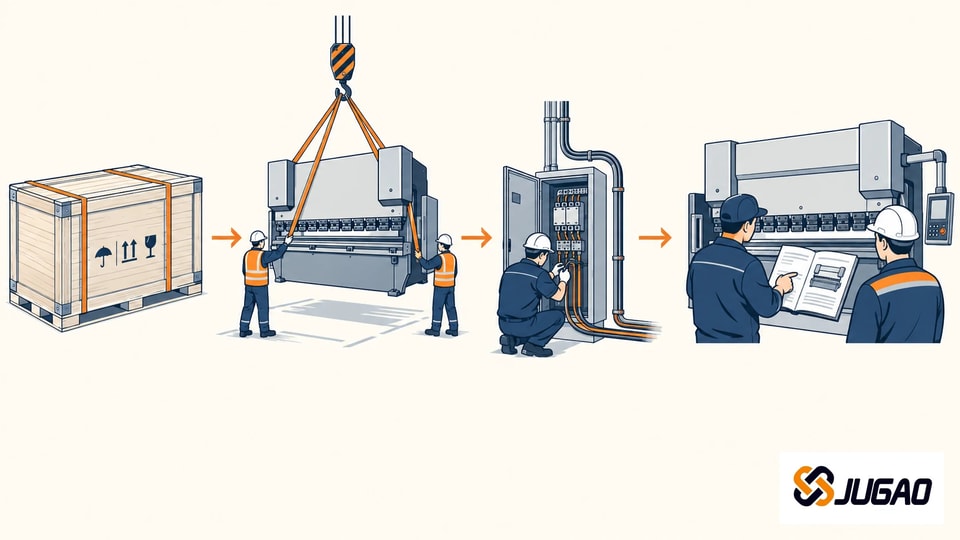
Before dispatch, confirm the packing list, machine identity and documents. At destination, name who unloads, provides lifting equipment, checks access and floor conditions, connects utilities and may energize the machine. At commissioning, record what was installed, what was trained, and which manuals and drawings were handed over.
Define whether warranty starts at shipment, installation, commissioning or acceptance. State scope, exclusions, parts/labor/travel/freight responsibility, service channel, escalation owner and critical spares. These are buyer questions—not claims about JUGAO’s warranty, delivery schedule, inventory or response time, which require written confirmation.
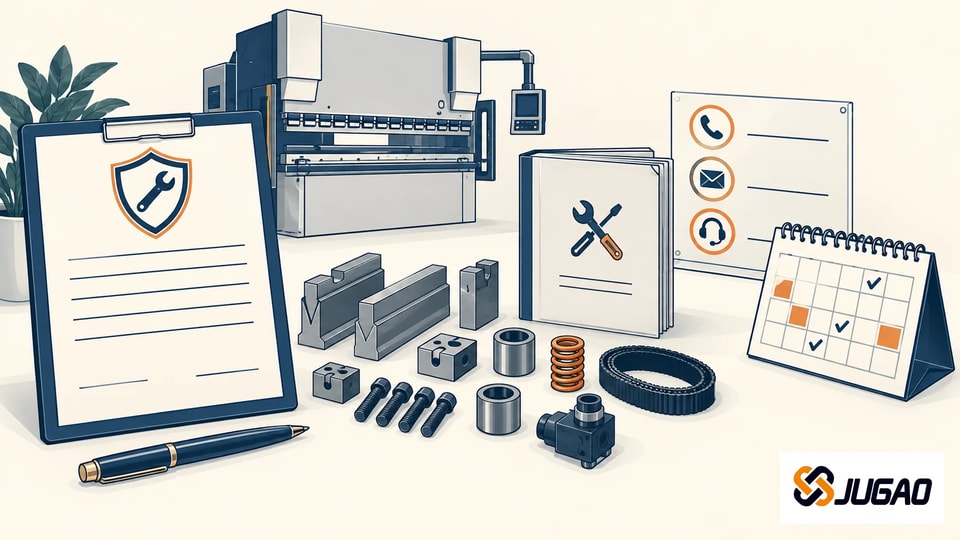
For a US destination, OSHA’s power-press-brake guarding guidance is a US safety-background reference. It is not a machine certification or global compliance opinion. Confirm current destination requirements, machine/process safeguards and responsibility for the compliance file with the appropriate local team.
08 / Which red flags deserve a pause?
- The seller will not identify the contracting and warranty entities.
- A controller model is used instead of an axis-by-axis configuration.
- A generic thickness chart replaces calculations tied to the representative job.
- An old video or unnumbered image stands in for a machine-specific FAT record.
- Freight, unloading, power, installation, training or documents are left “to be discussed.”
- Two prices differ in tooling, options, delivery or acceptance boundary but are ranked by total alone.
- “Fast support” has no channel, owner, parts route or escalation step.
A red flag is not proof that a supplier cannot perform. It is a reason to pause, ask a dated clarification and place the answer in the configuration, delivery or acceptance record. If a supplier cannot document an answer yet, mark it missing rather than filling the gap with a guess.
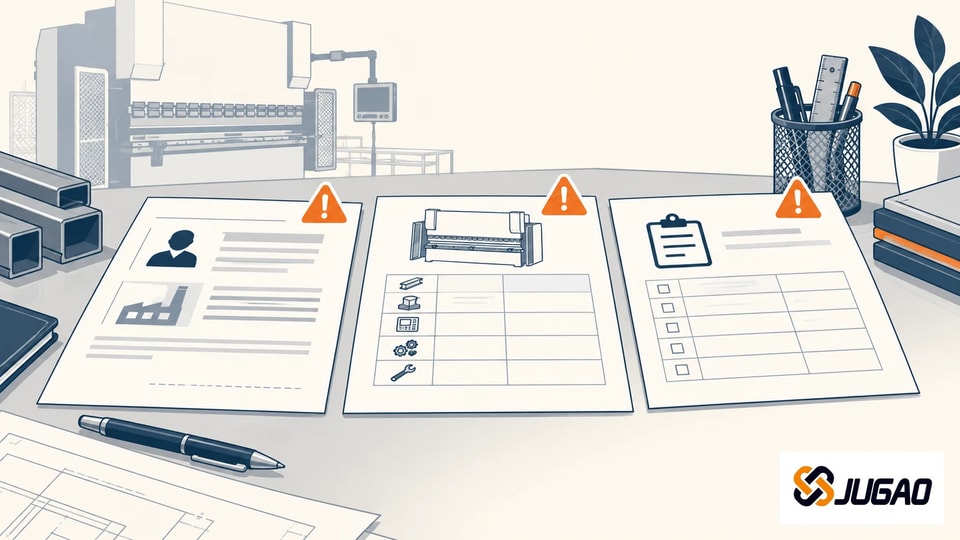
09 / Copy this RFQ and acceptance checklist
Send the same list to every supplier. Mark each response “received and order-specific,” “received but generic,” “missing” or “unresolved.”
PRESS BRAKE RFQ / ACCEPTANCE CHECKLIST
Supplier role: manufacturer / OEM / dealer / exporter
Contract and invoice entity:
Machine model and serial number:
Configuration version, issue date and validity:
Nominal pressure and working-table fields:
Controller model and axis-by-axis list:
Backgauge, tooling interface, tools and rated loads:
Safety equipment and destination voltage/frequency:
Included / optional / buyer-supplied / excluded:
Representative parts and material assumptions:
FAT sample, measurement method and acceptance criteria:
Observed result, defect, owner and due date:
Re-test method, result and sign-off:
Final acceptance conditions and signatures:
Manuals, electrical/hydraulic drawings and parts list:
Packaging, shipping, unloading and receiving responsibility:
Installation, commissioning, operator training and handover:
Warranty start, scope, exclusions, parts/labor/freight:
Service channel, escalation owner and critical spares:
10 / Frequently asked questions
How do I verify that a press brake supplier is the actual manufacturer?
Ask for its legal entity and written manufacturer/OEM/dealer role, then identify the contract, invoice, warranty, installation and service owners. Do not infer the role from branding.
What should a quotation specify besides tonnage and bed length?
Model and version, controller, actual axes, backgauge, tooling interface and tools, safety equipment, voltage, included options, exclusions, destination scope and acceptance conditions.
What should be included in a press brake FAT?
Machine ID, signed configuration, representative sample, material/tool assumptions, measurement method, tolerance, observed result, defects, owner, due date, re-test and sign-off.
How do I compare two press brake quotes fairly?
Normalize the same part scope, configuration, tools, destination, delivery boundary, documentation, installation and acceptance method. Do not rank different scopes by total alone.
What documents should arrive with an exported press brake?
Agree the manuals, electrical and hydraulic drawings, parts list, packing/shipping documents, installation instructions, safety file and training materials required at the destination.
Does a controller model prove the machine’s axis configuration or compliance?
No. A controller page describes controller functions. The actual machine axes, drives, software options and safety configuration must be stated for the quotation and confirmed for the order.
What service and spare-parts information should I confirm before payment?
Confirm warranty start and exclusions, parts/labor/freight responsibility, service channel and hours, escalation owner, critical spares and prerequisites for remote or site support.
Make the next conversation easier
Use the checklist to create one common RFQ, one dated configuration, one blank FAT record and one written service route. To explore machine families, browse the JUGAO bending machine category. When your part range and destination assumptions are ready, send a non-confidential RFQ through JUGAO’s contact page. The contact page is an inquiry path, not proof of the contracting entity or the role assigned to a particular order; confirm those in the quotation and contract.
References
- JUGAO 125TON/3200 T15 technical specification
- JUGAO DA-66T press brake route
- JUGAO bending machine category
- JUGAO contact / RFQ
- Delem DA-66T controller
- WILA air bending
- OSHA power press brake guarding guidance (US context)
© 2026 JUGAO. All rights reserved. Except for materials credited to third parties, the original text, graphics and design of this article are owned by JUGAO. Unauthorized reproduction or redistribution is prohibited.
Contact Us