
What causes the deviation in the bend angle?
2026-04-22

In pipe bending, the most common quality complaint is the discrepancy between the actual angle and the set value. This deviation can stem from issues with materials, equipment, molds, or processes. Below are the main causes and solutions.
1. Insufficient Springback Prediction
Cause: Materials exhibit elastic recovery after bending, especially high-strength steel, stainless steel, and aluminum, which have significant springback. If over-bending compensation is not set in the program, the finished angle will be too small.
Solution: Measure the springback amount through trial bending and increase the over-bending angle value in the program; or use a stretch bending process to reduce springback.
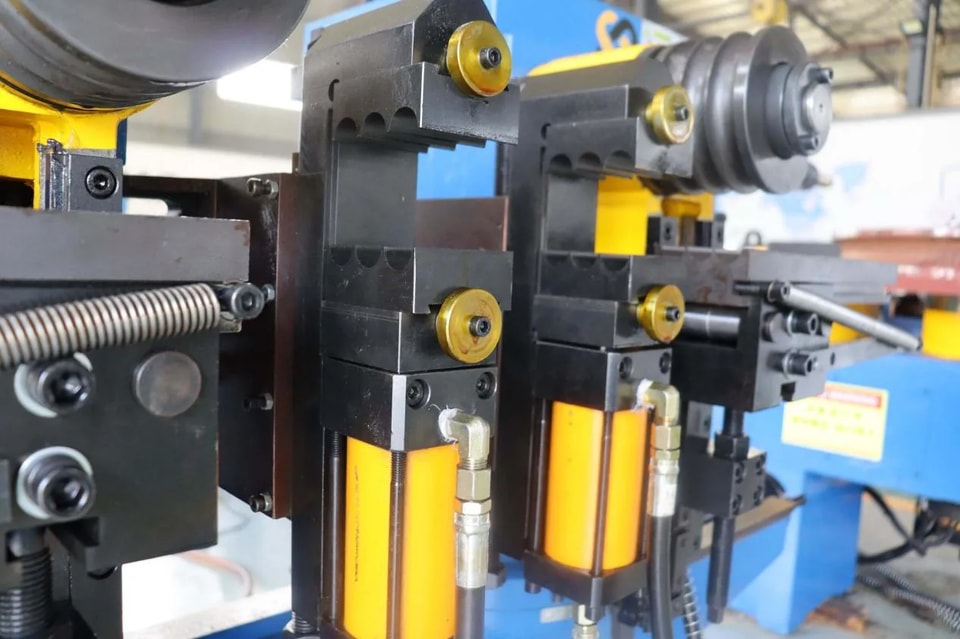
2. Insufficient Clamping Force or Slippage
Cause: Insufficient clamping die pressure causes axial slippage of the pipe during bending, leading to uncontrolled angle.
Solution: Check the clamping cylinder pressure to ensure it reaches the set value; clean the working surface of the clamping die; add anti-slip texture or replace the clamping die if necessary.
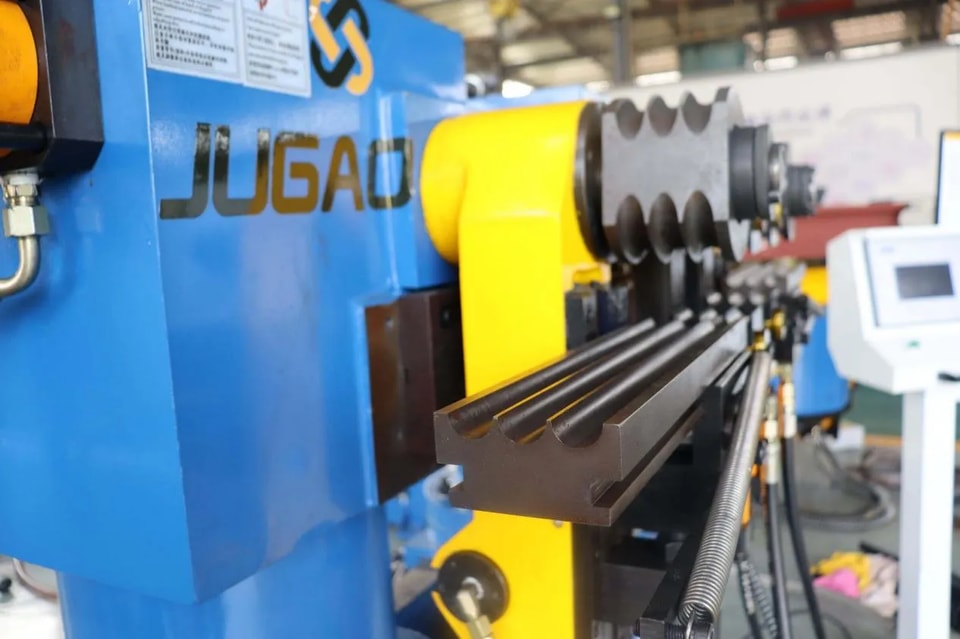
3. Die Wear or Loosening
Cause: Wear of the bending die or clamping die reduces the fit with the pipe; loose die fixing bolts cause displacement during bending.
Solution: Check the wear condition of the die and repair or replace it promptly; tighten the bolts diagonally with a torque wrench.
4. Encoder/Angle Sensor Failure
Causes: Loose encoder coupling, oil contamination on sensor surface, poor signal wire contact, leading to distorted angle feedback.
Solutions: Check coupling tightness; clean sensor surface; check wiring and recalibrate zero point.
5. Unstable Hydraulic System Pressure
Causes: Oil pump wear, stuck relief valve, excessively high oil temperature causing pressure fluctuations, resulting in inconsistent actual force when bending to the correct position.
Solutions: Check hydraulic oil level and cleanliness; clean or replace relief valve; maintain oil temperature between 35-50℃.
6. Improper Mandrel Position
Causes: Excessive or insufficient mandrel extension alters the stress state during pipe bending, indirectly affecting the angle.
Solutions: Adjust mandrel extension position; generally, the center of the first ball joint of a ball-end mandrel should be 0.5-1.5mm before the bending die-cutting line.
7. Excessive Bending Speed
Causes: During high-speed bending, material deformation cannot be evenly distributed, changing springback characteristics and resulting in poor angle consistency. Solution: Reduce bending speed, especially when machining high-precision or high-spring-resistance materials.
Quick Troubleshooting Sequence
1. Check if the clamping force is sufficient (check for slippage marks on the pipe).
2. Verify the bending angle compensation value in the procedure.
3. Check if the encoder coupling is loose.
4. Confirm that the hydraulic system pressure and oil temperature are normal.
5. Perform a trial bend on the first piece and measure, fine-tuning the parameters.
Angle deviations mostly stem from insufficient springback compensation or clamping slippage. Precise control of these two factors can significantly improve the pass rate.
Contact Us