
Rapid Troubleshooting for Assist‑gas Pressure Failures of JUGAO Laser Cutting Machines
2026-09-18

Table of Contents
1. The Critical Role of Gas Pressure Within Laser Cutting Operations
2. Primary Root Causes for JUGAO Assist‑gas Pressure Abnormalities
○ Inadequate Output Pressure From Gas Supply Source
○ Leakage on Gas Pipelines and Connection Fittings
○ Blocked Gas Filter Elements
○ Malfunctioning Pressure Regulating Valves
○ Partially‑clogged Nozzle or Internal Gas Flow Channels
3. Step‑by‑step Diagnostic Workflow for Gas‑pressure Troubleshooting
○ Step 1: Carry Out Inspection for the Original Gas Supply Source
○ Step 2: Read and Compare Readings From All Pressure Meters
○ Step 3: Complete System‑wide Air‑tightness Leakage Test
○ Step 4: Examine the Working Condition of Gas Filters
○ Step 5: Perform Visual Check for Laser Cutting Nozzle
○ Step 6: Assess Actual Performance of Pressure Regulators
4. Preventive Maintenance Rules for Stable Assist‑gas Supply
○ Build Standard Periodic Inspection Workflows
○ Implement Timely Replacement for Filter Cartridges
○ Keep Cutting Nozzles Thoroughly Cleaned
○ Track Real‑time Gas Consumption Data
5. Typical Warning Symptoms of Gas‑pressure Malfunctions
6. Frequently Asked Technical Questions
7. Final Conclusion
Abnormal assist‑gas pressure counts as one of the frequent malfunctions that harm processing finish, workshop output and operational stability of JUGAO laser cutters. When you observe heavy dross attachment, partial non‑penetration of plates, coarse kerf surfaces or fluctuating cutting performance, unstable or insufficient assist‑gas pressure is highly likely to be the underlying trigger. This technical guide illustrates practical diagnosis ideas for gas‑related faults on JUGAO laser equipment, sorts out prevailing failure sources, and offers actionable solutions to bring back ideal machining capability. Whether you work as front‑line operator, maintenance technician or production supervisor, this document helps you shrink unplanned standstill hours and sustain repeatable cutting quality for daily manufacturing.
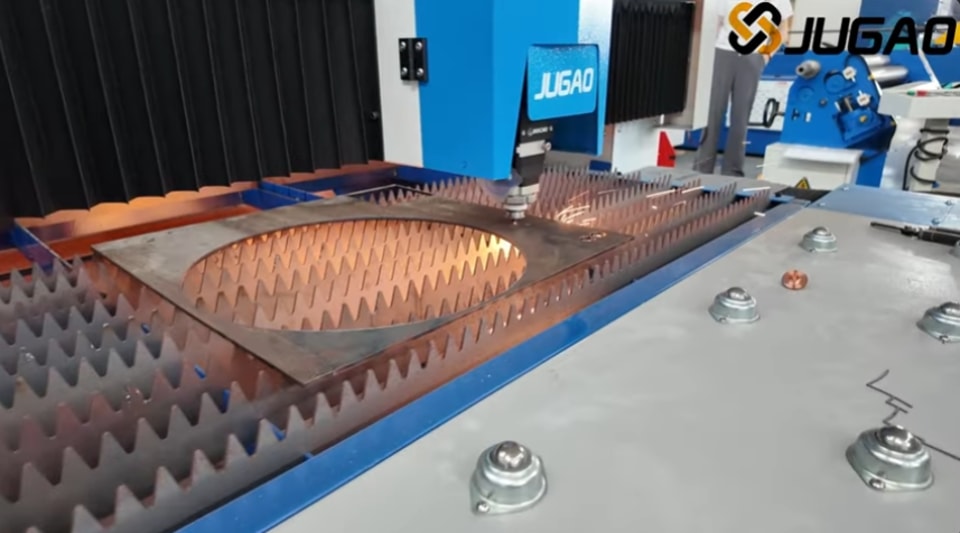
The Critical Role of Gas Pressure Within Laser Cutting Operations
Auxiliary process gas undertakes multiple core missions throughout laser cutting: blowing away molten metal inside cutting slits, cooling local high‑temperature processing zones, as well as shielding internal optical lenses from spatter pollution.
If gas pressure drops below the factory‑specified threshold, a series of undesirable processing defects will emerge:
• Heavy burr and dross accumulation on workpiece edges
• Material cannot be fully penetrated during cutting
• Burn traces appear on cutting cross‑sections
• Maximum achievable cutting velocity decreases
• Deteriorated dimensional consistency of finished parts
• Nozzle gets contaminated by molten residues more frequently
Recognizing these typical warning symptoms lays the groundwork for effective fault diagnosis of gas‑pressure issues.
Primary Root Causes for JUGAO Assist‑gas Pressure Abnormalities
Inadequate Output Pressure From Gas Supply Source
The most straightforward trigger lies on insufficient pressure output at the gas supply end. Empty gas cylinders, defective air compressors or unstable gas generating units will lower pressure delivered toward JUGAO laser cutter. Technicians should validate source pressure data before checking downstream components.
Leakage on Gas Pipelines and Connection Fittings
Gas leakage will consume pressure before the airflow arrives at laser cutting head.
Common leak‑prone locations contain:
• Flexible hose connecting joints
• Quick‑release coupling components
• Solenoid valve assembling interfaces
• Pressure regulator mounting points
• Gas distribution manifold assemblies
Even tiny leakage points can produce obvious negative impacts especially under high‑pressure cutting conditions.
Blocked Gas Filter Elements
Gas filters are designed to trap moisture, oil mist and solid impurities inside gas streams.
As operating time accumulates, filter interiors will be obstructed by contaminants, generating flow resistance and pressure loss. Dirty filter cartridges represent a major contributor to unstable assist‑gas supply.
Malfunctioning Pressure Regulating Valves
Pressure regulators take charge of adjusting output pressure fed into laser equipment.
A damaged pressure regulator may exhibit these phenomena:
• Delivering pressure value lower than preset target
• Obvious pressure swing during processing cycles
• Unable to hold steady pressure setting
Sharp fluctuation on pressure gauges requires immediate inspection on regulator assemblies.
Partially‑clogged Nozzle or Internal Gas Flow Channels
Splashed molten slag and metal debris may partly block nozzle holes or internal gas passages.
Under this circumstance, inlet pressure reading still appears normal, yet actual effective gas flow and pressure acting on cutting area becomes insufficient.
Step‑by‑step Diagnostic Workflow for Gas‑pressure Troubleshooting
Step 1: Carry Out Inspection for the Original Gas Supply Source
Begin diagnosis from the gas supply origin.
For cylinder‑based gas supply system:
• Confirm residual pressure inside gas cylinders
• Verify on‑off status of cylinder valves
• Rule out the situation that gas cylinders are nearly exhausted
For on‑site gas generators or air compressors:
• Check real‑time working pressure
• Observe whether any alarm signal pops up
• Confirm stable continuous gas output
Record all pressure readings for subsequent comparative analysis.
Step 2: Read and Compare Readings From All Pressure Meters
Check every pressure gauge distributed over the whole gas supply pipeline.
Make comparison among:
• Raw pressure value at gas source
• Output pressure after pressure regulator
• Inlet pressure received by JUGAO laser machine
Large‑magnitude pressure drop between two measuring points indicates flow blockage or gas leakage within this pipeline segment.
Step 3: Complete System‑wide Air‑tightness Leakage Test
Apply leak‑detecting liquid or professional electronic leak‑detecting instrument.
Focus inspection targets:
• Pipe threaded joints
• Flexible hose connection positions
• Fittings mounted on pressure regulators
• Solenoid valve group assemblies
Repair all detected leakage points before moving on to further diagnosis steps.
Step 4: Examine the Working Condition of Gas Filters
Dismantle gas filter units for physical inspection.
Check for these conditions:
• Dust and particle accumulation inside filter housing
• Condensed moisture contamination
• Residual oil‑stain sediment
Replace clogged filter elements following JUGAO official maintenance requirements.
Step 5: Perform Visual Check for Laser Cutting Nozzle
Damaged or heavily contaminated nozzle will distort gas flow pattern.
Inspect for:
• Solidified spatter adhering to nozzle aperture
• Nozzle tip deformation
• Serious surface abrasion
• Partial aperture blockage
Carry out cleaning operation or install brand‑new JUGAO original nozzle as required.
Step 6: Assess Actual Performance of Pressure Regulators
Tweak adjustment knob of pressure regulator and observe variation on pressure meter.
A well‑functioning pressure regulator should satisfy these features:
• Smooth response to manual adjustment
• Keep output pressure stable under dynamic working conditions
• Pressure value can rapidly restore stability after flow change
Swap out defective regulator components if pressure cannot maintain steady status.
Preventive Maintenance Rules for Stable Assist‑gas Supply
Build Standard Periodic Inspection Workflows
Weekly inspection for gas‑system assemblies is highly recommended.
Inspection scope covers:
• Pressure gauge working status
• Regulator operating performance
• Dirt accumulation inside filter parts
• Aging degree of gas hoses
• Opening‑closing condition of various valves
Routine check helps discover potential risks long before they interfere with formal production.
Implement Timely Replacement for Filter Cartridges
Quite a number of gas‑pressure failures are caused by neglected filter maintenance.
Follow JUGAO‑suggested replacement cycles and keep sufficient spare filter elements in‑stock.
Keep Cutting Nozzles Thoroughly Cleaned
Carry out nozzle cleaning work at the start and end of every production shift.
Clean nozzle parts guarantee consistent gas stream and reliable cutting outcomes.
Track Real‑time Gas Consumption Data
Abrupt upward change of gas consumption usually hints hidden leakage or system performance degradation. Keeping records of gas‑use trends enables early identification of developing faults.
Typical Warning Symptoms of Gas‑pressure Malfunctions
Pay attention to these typical abnormal manifestations:
• Rough and uneven cutting edges
• Heavy dross and burr generation
• Workpiece cannot be fully cut‑through
• Declined maximum cutting feed speed
• Nozzle gets contaminated very frequently
• System triggers gas‑pressure related alarm messages
• Unstable processing quality among workpieces in one batch
Early recognition of these signs can avoid expensive production suspension incidents.
Frequently Asked Technical Questions
Q1: Which fault occurs most frequently for laser cutting gas‑pressure systems?
The most‑seen troubles are insufficient effective gas pressure brought by pipeline leakage, blocked filter cartridges and failed pressure regulators.
Q2: Will low assist‑gas pressure exert negative influence over cutting quality?
Absolutely. Insufficient gas pressure leads to burr defects, incomplete cutting penetration, poor edge finish and decreased overall production efficiency.
Q3: What is the suggested inspection frequency for the whole gas supply system?
Carry out weekly spot‑check; execute comprehensive system maintenance every month. Adjust interval properly according to actual daily operating load of JUGAO laser cutter.
Final Conclusion
Quick diagnosis for assist‑gas pressure anomalies plays a vital role in preserving cutting finish, production capacity and equipment reliability of JUGAO laser cutting machines. Through orderly inspection covering gas source, pressure meters, regulators, filters, pipelines and nozzles, maintenance staff can locate root causes and restore normal system performance with minimal production downtime.
Scheduled inspection and proactive preventive maintenance represent the best method to prevent gas‑pressure‑related failures from disturbing manufacturing procedures. If you encounter persistent gas‑system malfunctions and require professional technical resources, feel free to reach JUGAO technical‑support team for specialized consultation and troubleshooting guidance.
Contact Us