
Complete Safety Operation & Maintenance Manual for JUGAO Supporting Air Compressor Systems
2026-07-11

Table of Contents
1. Basic Composition & Working Principle of JUGAO Air Compressor Matching System
2. Standard Safe Operation Process Step by Step
○ Pre-operation Comprehensive Safety Inspection Items
○ Standard Boot Sequence (Core to Guarantee System Safety)
○ Real-time Monitoring & Operation Specifications During Equipment Running
3. Common Hidden Safety Hazards of Compressed Air Equipment & Targeted Solutions
4. Tiered Maintenance Plan to Secure Long-Term Safe Operation
○ Daily Routine Inspection & Maintenance Work
○ Monthly Deep Cleaning & Component Replacement Work
○ Annual Full Inspection & Calibration Work
5. Quick Troubleshooting for Frequently Occurring Equipment Malfunctions
6. Final Summary: Core Safety Operation Key Points
Master standardized safety operation specifications for air compressor supporting equipment, including the correct startup order of cold dryer and main compressor, layered maintenance checklists and fast fault elimination methods, to avoid safety accidents in the workshop. Air compression supporting equipment is essential auxiliary equipment for JUGAO laser cutting machines, widely used in sheet metal processing factories, yet non-standard operation is a major hidden danger of industrial equipment failures. Relevant industrial safety statistics show that faults caused by irregular compressed air systems account for nearly one-tenth of all mechanical equipment safety incidents every year. This full guide sorts out complete safety operation standards specially matched for JUGAO laser cutting supporting air compressors, covering the error-prone startup sequence of cold dryer and compressor ignored by most factories, as well as regular maintenance items that can avoid serious equipment damage.
You will learn that standardized startup steps are not only for improving operating efficiency, but also directly avoid sudden shutdown failures caused by moisture corrosion. Regular weekly inspection work can greatly extend the overall service life of air compression supporting equipment. Most importantly, you can establish a complete equipment safety management system to protect both JUGAO laser cutting production equipment and on-site operators.
1. Basic Composition & Working Principle of JUGAO Air Compressor Matching System
2. 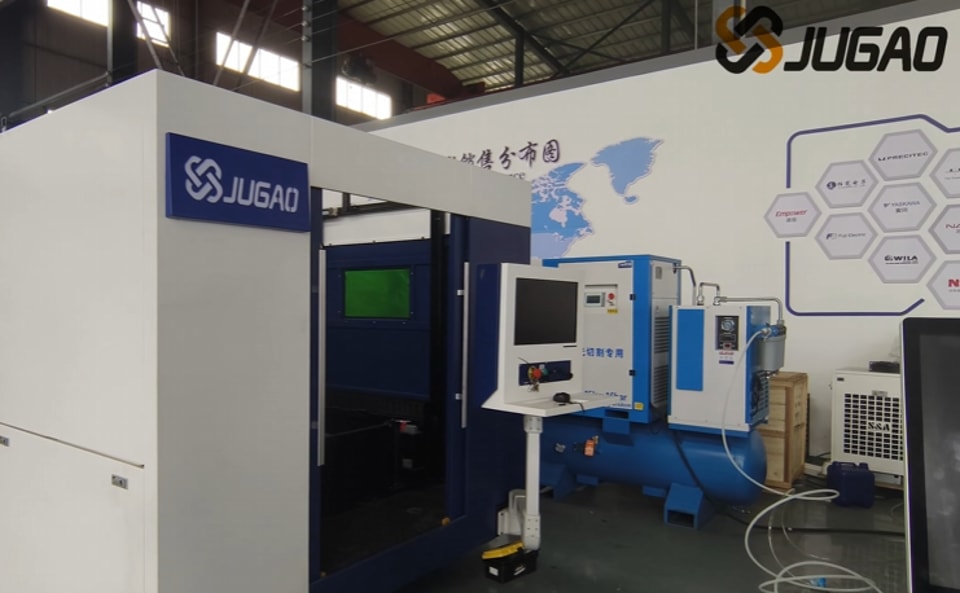
To carry out standardized safety management of air compression equipment, you need to fully understand the overall structure of the supporting system matched with JUGAO laser cutters. A complete industrial compressed air supporting system consists of the following core parts:
• Screw air compressor unit: Adopt screw rotary compression structure, divided into oil-injection and oil-free two types for different laser processing demands
• Post-cooler: Rapidly reduce the temperature of high-temperature compressed air to separate internal water vapor
• Refrigerated drying machine: Must be started in advance to remove water vapor in air before gas enters the compressor main unit
• Air storage tank and multi-stage precision filter: Stabilize output air pressure and intercept metal dust, oil mist and other impurities
Why Start the Cold Dryer First?
If humid untreated air directly enters the compressor body, internal metal parts will suffer accelerated corrosion, compressor lubricating oil will be polluted and deteriorated, and the overall operating efficiency of the whole set of equipment will drop by up to 30%.
2. Standard Safe Operation Process Step by Step
Pre-operation Comprehensive Safety Inspection Items
Before starting the whole air compression supporting system, complete all pre-start safety inspections. These preventive inspection steps can effectively eliminate potential safety risks and reduce unexpected shutdown loss of JUGAO laser cutting production lines.
Inspection of Refrigerated Dryer
1. Power supply and pre-cooling preparation: Confirm the cold dryer is powered on normally, keep it running for at least 5 minutes of pre-cooling time. This step ensures the internal dehumidification structure reaches the working temperature, fully remove water vapor in air and prevent corrosion damage to the compressor unit.
2. Condensate drain valve inspection: Check whether the automatic drain valve is unobstructed and operates normally. Blocked drain pipelines will lead to accumulated water inside the dryer, bring moisture back into the air circuit, and trigger equipment efficiency reduction or component corrosion damage. Regular cleaning and inspection can stabilize air supply quality and avoid all kinds of water-related faults.
Inspection of Screw Compressor Main Unit
1. Lubricating oil liquid level: Check the oil scale of the compressor fuel tank, ensure the liquid level stays between the upper and lower limit marks. Sufficient lubricating oil can reduce friction loss of moving parts, guarantee stable mechanical operation and maintain constant working efficiency.
2. Drive belt tightness: Check whether the transmission belt has uniform tension, no cracks, wire drawing or slipping phenomena. Stable belt transmission can ensure full power output and avoid sudden shutdown caused by belt breakage.
3. Surrounding heat dissipation space: Reserve at least 0.9 meters of empty space around the compressor unit for air circulation. Blocked heat dissipation channels will cause continuous temperature rise, trigger thermal overload protection and damage internal components.
Standard Boot Sequence (Core to Guarantee System Safety)
1. Start the refrigerated dryer first: Turn on the cold dryer and wait for the display screen to show stable dew point value (standard value around 3°C). This indicates the dehumidification function is fully activated, isolating excess water vapor and protecting the compressor unit from damp corrosion.
2. Start screw compressor under unloading mode: Boot the main unit and keep it running idle for about 30 seconds to stabilize internal pressure and temperature. This operation reduces instantaneous impact load on mechanical parts and avoids component damage during switching to load operation.
3. Gradually switch to load mode: Slowly switch the compressor to load operation state to prevent instantaneous pressure surge. Gentle pressure rise can keep the whole air circuit system stable and avoid pipeline and tank pressure overload damage.
Real-time Monitoring & Operation Specifications During Equipment Running
1. Real-time observation of instrument data
○ Cold dryer index: Focus on dew point reading; once the value exceeds 10°C, it means the dehumidification function fails and needs immediate maintenance
○ Compressor running parameters: Monitor lubricating oil temperature (control below 90°C) and air pressure, ensure all data are within the factory rated range. Exceeding standard parameters represents abnormal operation and requires timely troubleshooting.
2. Listen for abnormal running sounds: Pay close attention to grinding, impact and other strange noises during operation, which often signal bearing wear or mechanical component failure. Timely maintenance can avoid expensive overall overhaul.
3. Common Hidden Safety Hazards of Compressed Air Equipment & Targeted Solutions
Safety Risk | Root Cause | Preventive Control Measures |
Compressor oil fire accident | Long-term overheating + pipeline oil leakage | Install temperature sensing alarm device; conduct weekly oil pipeline tightness inspection |
Air storage tank explosion risk | Internal corrosion failure + pressure relief valve without regular testing | Discharge accumulated water in the tank every day; complete pressure relief valve calibration test every six months |
Electric shock safety accident | Wiring exposed in humid workshop environment | Equip all equipment with waterproof electrical boxes; do full grounding treatment for the whole air compression system |
4. Tiered Maintenance Plan to Secure Long-Term Safe Operation
Form a standardized phased maintenance plan to guarantee stable performance and extend service life of air compression supporting equipment, simultaneously improving the overall safety of JUGAO laser cutting workshop gas supply system.
Daily Routine Inspection & Maintenance Work
1. Discharge accumulated water in air storage tank and cold dryer every day: Long-term accumulated water will corrode tank inner wall and pipeline, damage air supply quality. Daily drainage can effectively reduce corrosion failure probability and improve equipment safety.
2. Soap water air tightness test: Use soap water to check all pipeline joints, flanges and sealing positions for air leakage. Air leakage will cause insufficient air pressure for JUGAO laser cutting heads, reduce processing efficiency and increase energy consumption. Daily inspection ensures stable air pressure and safe operation.
Monthly Deep Cleaning & Component Replacement Work
1. Replace compressor air intake filter element monthly: The filter intercepts dust and metal debris in workshop air. Blocked filter will increase unit load, reduce efficiency and accelerate internal component wear. Timely replacement keeps stable gas intake and equipment safety.
2. Clean cold dryer condenser fins every month: Dust covering the fins blocks heat exchange airflow and causes dryer overheating. Regular cleaning guarantees stable dehumidification performance and avoids subsequent compressor failure.
Annual Full Inspection & Calibration Work
1. Annual lubricating oil sampling test: Send compressor oil samples for laboratory detection to judge oil deterioration degree and internal component wear condition. Early discovery of impurity and wear particles can prevent serious mechanical faults.
2. Calibrate pressure control switches once a year: Ensure all pressure control components work within safe rated range. Accurate calibration avoids ultra-high pressure hidden dangers and improves overall system stability.
Supplementary Remarks:
This equipment belongs to high-pressure gas storage and compression equipment; it is recommended to adopt original factory designated spare parts or high-quality parts with higher standard than original matching.
Special supporting oil for high-pressure unit: 46# semi-synthetic compressor oil
Air intake filter: 3μm precision filter element
Oil filter: High pressure resistant dedicated filter core
Oil-water separator: Custom thickened separator specially matched for JUGAO laser cutting equipment
5. Quick Troubleshooting for Frequently Occurring Equipment Malfunctions
Fault 1: Compressor cannot start normally after cold dryer startup
1. Check cold dryer fault codes: Read the alarm information on the dryer display screen such as high-pressure protection alarm, judge whether the dryer itself breaks down, and eliminate the fault first. Abnormal dryer operation will directly affect compressor startup and bring moisture corrosion damage risk.
2. Detect compressor power supply circuit: Use multimeter to test input voltage, unstable power supply will lead to startup failure. Fasten all wiring terminals to avoid electric hidden dangers and startup abnormality.
3. Inspect motor startup capacitor: Capacitor aging and damage are common startup failure causes. Replace damaged capacitors in time to prevent motor overload burnout.
Fault 2: Frequent automatic startup and shutdown of the unit (fast cycle switching)
Frequent start-stop operation brings repeated impact load to mechanical parts, reduces service life and brings potential safety risks.
1. Blocked cold dryer filter element: Filter clogging increases pipeline resistance, forcing the compressor to start and stop repeatedly. Regular cleaning and replacement of filter elements can maintain smooth air circuit and stable operation.
2. Damaged pressure control switch: The switch cannot accurately feed back tank pressure signal, leading to abnormal start-stop. Calibrate or replace pressure switches to stabilize system pressure and reduce mechanical loss.
Complete Common Fault Troubleshooting Table
Serial Number | Fault Phenomenon | Cause Analysis | Processing Solution |
1 | Main unit head oil leakage | Shaft seal aging or incorrect installation | Disassemble and replace new shaft seal |
2 | Unable to start the whole unit | Low voltage, mismatched wire specification, blown fuse, phase loss, pressure sensor damage, motor failure | Check power supply voltage; replace matching wire and fuse; adjust power phase; replace pressure sensor; repair or replace driving motor |
3 | Exhaust air humidity too high leading to shutdown | Too much lubricating oil leakage, high ambient temperature, dirty cooler, oil deterioration, blocked oil pipeline, temperature sensor failure | Add lubricating oil; improve workshop ventilation; clean cooler; replace deteriorated oil; unclog oil pipeline or replace temperature sensor |
4 | Exhaust air carries excessive oil | Overfilled oil, oil return pipe installation error, expired oil separator and filter core | Drain excess oil; reposition oil return pipe; replace oil separator and all filter cores |
5 | Exhaust contains a large amount of water | Cold dryer refrigerant shortage, dryer failure, blocked automatic drain valve | Add refrigerant; overhaul cold dryer; clean or replace drain valve |
6 | Exhaust pressure fails to reach rated value | Excessive air consumption, suction valve damage, pressure sensor failure, pipeline air leakage, blocked air filter | Inspect all above components one by one and repair damaged parts |
7 | Lubricating oil deteriorates rapidly | Unsuitable oil model, high ambient temperature, oil mixed with water, old oil not completely discharged | Replace special compressor oil; strengthen workshop heat dissipation; drain and clean fuel tank thoroughly |
8 | Abnormal vibration and running noise | Motor/compressor bearing wear, belt slipping, loose fasteners, two pulleys not on the same horizontal plane | Replace worn bearings; adjust belt tension; reinstall and calibrate pulley parallelism |
9 | Motor overheat automatic shutdown | Low input voltage, compressor jamming, non-special lubricating oil, loose wiring, ultra-high exhaust pressure | Repair power supply circuit; replace matching special oil; fasten wiring; adjust pressure to rated standard |
10 | Safety valve continuous air discharge | Over-standard exhaust pressure, damaged safety valve, pressure sensor failure | Adjust pressure setting; replace safety valve and pressure sensor |
6. Final Summary: Core Safety Operation Key Points
1. Cold dryer startup priority rule: Always turn on the refrigerated dryer before running the compressor main unit to avoid moisture corrosion and efficiency loss of the whole air circuit system.
2. Real-time tracking of air humidity index: Moisture erosion causes 80% of air compression equipment failures; timely dehumidification maintenance can effectively prolong equipment service life.
3. Strictly execute phased maintenance cycles: Standardized daily/monthly/annual maintenance can reduce 40% of on-site safety accidents, ensuring stable and reliable long-term operation.
4. Auxiliary learning suggestion: Watch the supporting air compressor safety operation teaching video to intuitively master standard startup, maintenance and fault elimination operation steps.
In conclusion, proactive regular maintenance can not only protect the investment of JUGAO workshop air compression equipment, but also build a safe production environment for operators. Abide by all the above safety operation standards and supporting maintenance specifications, your air compression supporting equipment can maintain long-term stable, safe and high-efficiency operation. Remember: well-maintained air compression equipment is the reliable guarantee for safe and stable laser cutting production.
Document Usage Tips
Copy all the above complete English text, paste it into WPS or Microsoft Word, click Save and select .docx format to generate an independent editable document for factory filing and training use.
Contact Us