
JUGAO Fiber Laser Cutting Machine Engineering Guide
2026-09-16

JUGAO Fiber Laser Cutting Machine Guide: 3015 Selection, Installation and Sheet-Metal Workflow
Plan a JUGAO cutting cell around the parts you actually make. This guide compares the published 2 kW 3015 machine with a supplied 3 kW configuration, then follows the route from site preparation and sample acceptance to bending and welding. It is written for fabrication-shop owners, production managers and engineering teams preparing a practical equipment specification.

Start with the JUGAO configuration that matches your work
The published 2 kW product is a useful starting point for discussing sheet cutting. The supplied January 2026 specification describes a separate 3 kW example. Treat power, source, cutting head, controller and auxiliary equipment as a configuration to confirm together.
Published 2 kW 3015 machine
Published model: ER3015-2000W, with a 3000 × 1500 mm working area. Use the product page to begin the enquiry, then request the current signed configuration.
Buyer decision: provide material grades, thickness distribution, sheet dimensions and representative drawings before choosing laser power.
3 kW project configuration
The supplied specification lists 3000 W, a 3000 × 1500 mm working area, a MAX source and water cooling. These values describe that project example, not every JUGAO laser.
Configuration check: the commercial summary and technical pages use different model names. Confirm the final model, nameplate and component schedule before ordering.
Sheet and tube requirements
JUGAO’s broader catalogue includes sheet-and-tube laser equipment. A tube-cutting attachment is a separate configuration decision; it is not established as standard on the 2 kW product.
For tube parts, specify section shape, diameter, wall thickness, length, loading method and required end cuts. Request a trial on your actual part.
Plan the next operation
Laser-cut blanks may continue to CNC press-brake forming, rolling or welding. Review bend lines, hole locations and clamping before freezing the cutting program.
Select the production route first. A faster cutting machine delivers limited benefit when deburring, forming, inspection or material handling becomes the bottleneck.
Prepare the complete cutting cell before the machine arrives
A JUGAO laser installation also needs an agreed plan for electrical supply, assist gas, cooling, extraction, loading and service access. The 3 kW example is a laser-output rating; it is not the total electrical demand of the workshop cell. Ask for the final layout and utility schedule for the ordered machine.
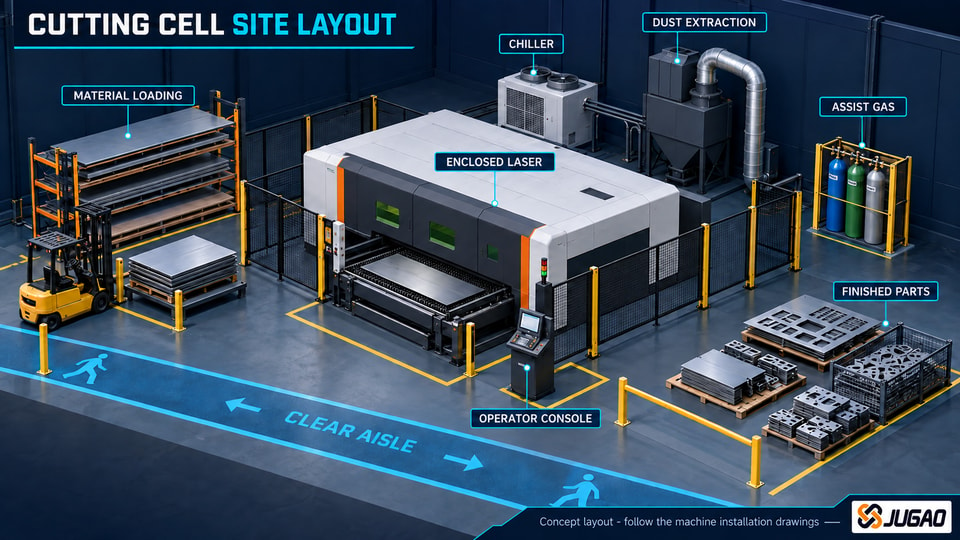
Field design checklist before delivery
- Power: use the complete load schedule, including source, drives, chiller, compressor and extraction. Have the electrical design checked for the destination site.
- Floor and handling: use approved machine mass, support loads, lifting points and layout. Conflicting weights in preliminary documents are not a foundation-design basis.
- Gas: agree the gas type, required flow, pressure and quality at the machine inlet. Size delivery equipment for demand under flow, not the tank pressure alone.
- Extraction: specify material and coating risks, capture performance and collection arrangements. The design must cover the actual cutting process and waste stream.
- Software: agree the licensed controller/software version, file format, training, parameter backup and restoration procedure.
Eight checks for installation and acceptance
Use these points as a project handover checklist. The manufacturer’s instructions, approved installation drawings and site risk assessment determine the detailed procedure. Electrical work and laser service belong to qualified personnel.
Floor and logistics
Check the approved layout, lifting plan, access route, floor loading, sheet storage and maintenance space against the delivered machine.
Power and grounding
Confirm the ordered voltage, phase and frequency. The attachment’s 380 V / 50 Hz statement must not be assumed suitable for every export site.
Cooling water
Follow the source and cutting-head manuals for coolant, setpoints and connections. Record the chiller model and demonstrate its alarm response.
Assist gas
Verify gas compatibility, rated pipework, treatment, leak checks and inlet performance under the agreed operating conditions.
Dust and fire control
Commission extraction and assess hot particles, collected dust, waste handling and fire response for the materials being processed.
Software and backup
Back up supplied parameters and software details. Record a controlled recipe for each accepted material/thickness combination.
Safety interlock
Have the supplier demonstrate the safety functions and alarm response. Record results and resolve faults before production; never defeat an interlock.
Trial cut and acceptance
Cut representative production drawings, inspect the agreed features and document settings, elapsed time, consumables and operator training.
Specify electricity, gas, cooling and extraction as one package
Request a connection schedule for the final JUGAO configuration. The illustration explains the functional relationships; it is not a wiring diagram, pipe-sizing calculation or installation drawing.
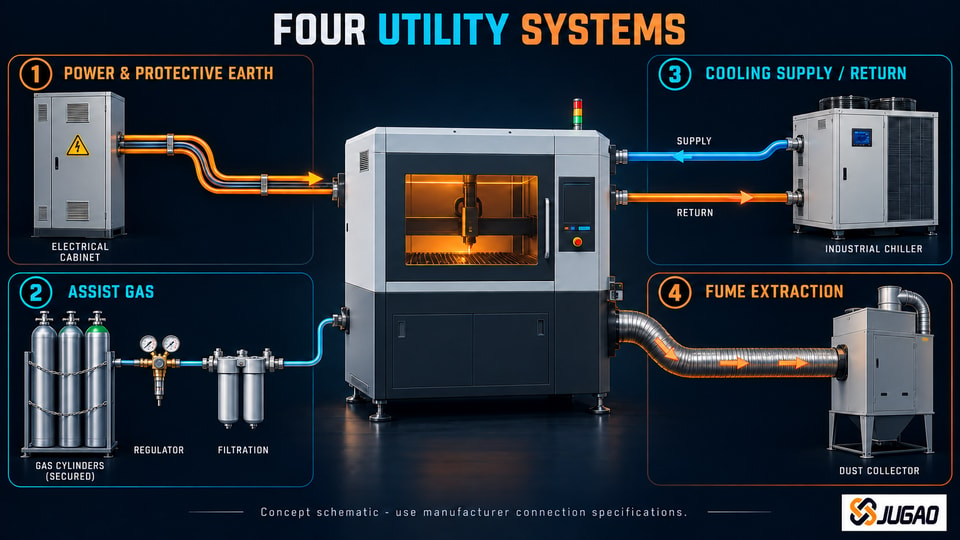
Electrical supply
The laser, motion system and auxiliary equipment may have different supply requirements. Obtain the machine electrical drawings, protective-earth requirements, isolation arrangement and total demand before sizing the site supply.
Assist-gas capacity
The attached 11 kW compressor table gives different flows at different pressures. Its 1.6 MPa rating is not proof of suitability for a higher-pressure cutting recipe. Confirm simultaneous flow, treatment and pressure losses with the supplier.
Cooling compatibility
A source or head substitution can change the cooling requirement. Confirm the chiller pairing, approved coolant and alarm connections. Include access for servicing without contaminating optics.
Fume and dust capture
Laser cutting can generate hazardous airborne contaminants. OSHA’s laser-hazard guidance discusses ventilation and nonbeam hazards. Plan source capture and evaluate exposure for the actual metals and coatings.
Make the delivered cutting head part of the acceptance record
The attachment lists a BOCI 321 cutting torch, while the published 2 kW product lists a different head configuration. Do not transfer nozzle, lens or focus instructions between heads without verification. Keep the supplied head manual, spare-part references and approved recipes with the machine.
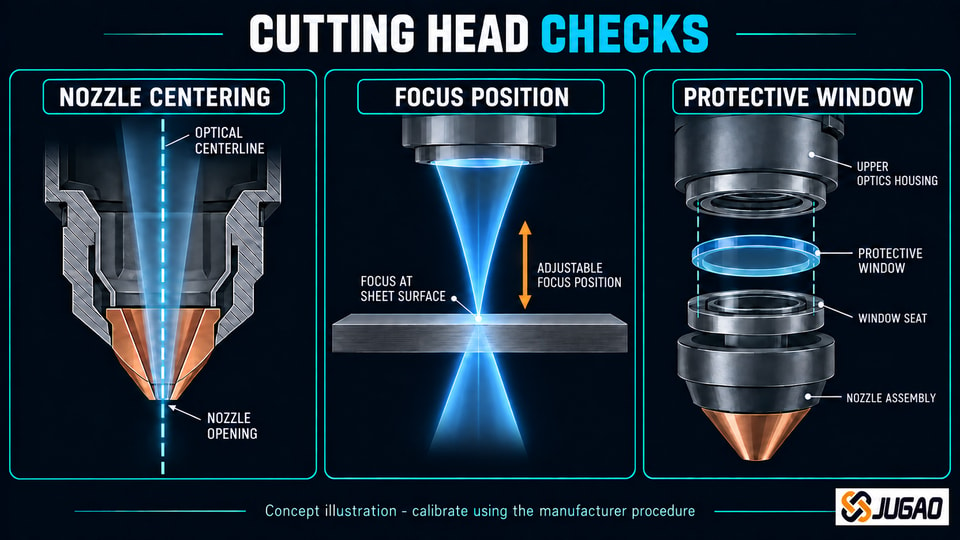
| Check point | What field engineers must verify |
|---|---|
| Head identity | Record the installed manufacturer, model, optical specifications and matching service manual. |
| Consumables | Confirm the correct nozzle, ceramic and protective-window references; agree a local stock and safe replacement procedure. |
| Focus and height sensing | Have the supplier demonstrate the approved setup and calibration procedure on the delivered head and controller. |
| Sample quality | Inspect holes, corners, contours and edges using the material and acceptance criteria agreed for the job. |
| Service boundary | Operator checks and specialist optical service are different tasks. Escalate alarms and recurring damage through the documented support process. |
Record symptoms before changing cutting parameters
When quality changes, save the job, material identification, recipe, alarm log and photographs. The table is a discussion aid for the JUGAO service team, not a substitute for the delivered machine’s fault-finding instructions. Stop operation when a safety function or essential utility is faulty.
| Defect | Likely cause | Diagnostic order |
|---|---|---|
| Dross or uneven edge | Material, recipe, gas delivery or consumable condition may have changed. | Compare with the accepted sample and record when the defect began; inspect only as permitted by the manual. |
| Quality varies by direction | Alignment, nozzle condition, sheet condition or motion may require examination. | Record direction and location; request the supplier’s prescribed diagnostic sequence. |
| Incomplete cut | The job may exceed the validated process window, or an alarm/utility issue may be present. | Stop and review material, program and logged conditions before authorising a controlled retest. |
| Distorted small features | Geometry, thermal effects or sequencing may be unsuitable for the recipe. | Send the drawing and sample to application support; validate any revised process on a coupon. |
| Repeated window damage | Contamination or process conditions may need specialist review. | Keep part numbers and service history; have approved personnel inspect the cause before restarting. |
| Visible fume escape | Capture performance may be inadequate or equipment may need maintenance. | Stop the affected process and have extraction performance assessed; do not rely on open doors. |
Build a spare-parts plan for the installed configuration
The project attachment lists spare lenses and nozzles, but a quantity alone is not a maintenance plan. Confirm exact part numbers, compatibility, lead times, storage and the personnel authorised to replace each item.
Cutting head consumables
Match nozzles, ceramics, protective windows and seals to the delivered cutting head. Keep packaged optics clean and identifiable.
Optics and fiber interface
Keep optical-interface service within the manufacturer’s authorised procedures. A spare part does not make internal laser service an operator task.
Gas treatment
List dryer and filter service items against the actual assist-gas equipment, together with the quality checks needed by the machine.
Cooling spares
Identify chiller service parts and approved coolant from its manual. Avoid assuming that generic antifreeze is compatible.
Motion maintenance
Follow the specified lubrication and inspection schedule for rails, racks and drives; document unusual noise or contour errors.
Dust collector parts
Specify extraction filters and waste-handling procedures for the material mix. Agree inspection and replacement criteria with the system supplier.
Connect JUGAO cutting, forming and welding around the same drawing
A practical enclosure route is blank preparation, laser cutting, deburring, bending, welding and inspection. JUGAO’s catalogue provides several of these equipment families; the production engineer still needs to match their capacities and verify the process between them.
Use the QC11K guillotine shear for suitable straight blanks, the 3015 fiber laser for contours and holes, and a JUGAO CNC press brake for formed panels. For the next step, review the fiber laser welding machine. The attachment’s 160-ton/3200-mm DA66T example is specified as 6+1 axes; it must not be assumed identical to the website’s 8+1-axis headline. Confirm tooling access, bend sequence, hole-to-bend relationships and cosmetic surfaces on the complete part.
Evaluate JUGAO by configuration, workflow and acceptance evidence
The two JUGAO websites show a broad metalworking portfolio. For a buyer, the useful comparison is a clearly specified package and demonstrated performance on real parts. Request evidence for your configuration rather than relying on general company-size figures or unsupported comparisons with other brands.
A defined machine package
List the source, head, controller, chiller, gas system, extraction and guarding separately. Mark each item as included, optional or supplied by the customer.
A repeatable process
Use a repeatable acceptance job. Record material, recipe, cut quality, complete cycle time and consumable condition; distinguish travel speed from production output.
Connected fabrication steps
Flat panels may need bending; cylinders may need W12 plate rolling; curved structural sections may need W24S-16 profile bending. These are different forming operations.
A documented handover
Agree manuals, drawings, training, spare-part identification and support contacts before delivery. Warranty, commissioning and response commitments must be explicit in the project agreement.
Translate market demand into specific fabrication work
Electrical cabinets, charging enclosures, equipment guards and industrial panels are practical topics for a sheet-metal workshop. The applications below are engineering possibilities, not claims that JUGAO supplies particular end customers or that a machine purchase guarantees orders.
| Downstream sector | Parts mapped to laser cutting | Sales and engineering angle |
|---|---|---|
| AI data centers | Server cabinets, PDU and UPS cabinets, busway covers, cold aisle containment, liquid-cooling CDU housings, brackets and cable trays. | Fast hole patterns, consistent cabinet panels, quick engineering change response and clean appearance surfaces. |
| BESS battery storage | Battery cabinets, PCS cabinets, fire-control housings, air duct panels, bottom bases, door panels and grounding brackets. | Stable galvanized steel, stainless steel and aluminum processing with repeatable enclosure dimensions. |
| EV charging and solar | Charger enclosures, inverter cabinets, combiner boxes, heat-dissipation plates and outdoor mounting brackets. | Accurate mounting holes, corrosion-resistant materials and mixed material production. |
| Smart factories | Robot guards, equipment covers, control cabinets, sensor brackets, cable trays and fixture plates. | Small-batch high-mix production from CAD/CAM to cutting, bending, welding and assembly. |
| Infrastructure and transport | Stainless panels, ventilation parts, elevator panels, rail covers, airport equipment panels and long structural covers. | Large-format sheets, cosmetic surfaces, installation-hole accuracy and heavy-duty downstream forming. |
IEA’s Global EV Outlook 2026 records more than 20 million electric-car sales in 2025, up 20%. Separately, the 2025 Energy and AI report projects data-centre electricity demand of about 945 TWh in 2030 in its Base Case. These are demand context, not laser-machine sales forecasts. The application inference is to investigate enclosure, bracket and cooling-housing work, then validate local drawings, orders and margins.
Use standards to define questions and acceptance criteria
Agree the applicable requirements with the supplier and the destination-site specialists. The references below explain relevant safety or quality subjects; linking a standard does not establish certification of the ordered machine.
IEC 60825-1:2014
Laser product classification and related requirements. Request classification and user information for the complete delivered product.
ISO 11553-1:2020
Laser-radiation safety for laser processing machines. This reference does not replace a wider review of fumes, electrical and fire hazards.
ISO 9013:2017
Thermal-cut geometry and quality tolerances; the catalogue also lists a 2024 amendment. Agree the relevant quality criteria in the purchase specification.
ISO 12100:2010
A framework for machinery risk assessment and risk reduction. Recheck the applicable edition when specifying a new project.
OSHA laser-hazard guidance
Reference material on beam hazards, ventilation and workplace controls. It is not a machine approval or a complete current legal checklist.
IEA Global EV Outlook 2026
Market evidence for electric-car adoption. Use it to frame research into downstream fabrication, with year and scope stated.
Explore JUGAO equipment for the next production step
These product pages belong to the JUGAO main website. Compare their published configuration with the specific machine offered for your project, and share the same drawings across cutting and forming discussions.
3015 Fiber Laser Cutting Machine
Published 2 kW sheet-cutting configuration; discuss power and auxiliary equipment for your material mix.
Open link →
DA-66T CNC Press Brake
Review press-brake capacity, tooling and axes for the laser-cut blank.
Open link →
QC11K Guillotine Shear
Consider straight blank preparation where it fits the part and production route.
Open link →
W12 Four-Roll Plate Rolling Machine
Evaluate cylindrical and curved plate parts with material strength and diameter specified.
Open link →
ER-63 CNC Pipe Bender
Review tube bending, feeding and rotation for framed or tubular products.
Open link →
JUGAO Fiber Laser Welding Machine
Consider the welding stage, joint preparation and required workplace controls.
Open link →
Prepare a sample brief that the application team can use
A useful enquiry makes the proposed JUGAO configuration testable. Include the part files, material grades, thickness distribution, monthly volume, surface requirements and site supply details.
Send the drawing, material and acceptance requirements together
Ask for a recorded trial of representative parts, the final component list, sample measurements and complete cycle timing. Specify which holes, edges, corners and formed dimensions matter. Agree a handover record covering settings, utilities, training, safety-function checks and the approved configuration.
Field questions installation teams ask before and after delivery
No. They share a 3000 × 1500 mm working-area description, but power and component schedules differ. The article treats them as separate configurations and requires the final signed specification.
No. The attachment labels this as maximum moving speed. Cutting speed and finished-part cycle time depend on material, geometry, piercing, acceleration, process settings and handling.
The power rating alone cannot answer that question. Match the required pressure, flow and air quality at the inlet to the compressor and treatment performance under operating conditions.
No. Review the documentation for the exact delivered model and destination, including the applicable declaration, instructions and safety provisions. A brochure checkbox is not that review.
The cut blank must fit the bending tool, sequence and final assembly. Reviewing both operations early helps expose geometry and handling constraints before production.
Send material grades, thickness mix, drawings, quantities, required finish and tolerances, available utilities and destination. Ask for a configuration-specific trial and acceptance plan.
Choose a verified JUGAO cutting configuration and a workable production route
Start with your drawings and finish with an agreed acceptance record. The right investment brings the machine, utilities, people and downstream processes together. Compare the published JUGAO products, then confirm the offered model and validate it on the parts your workshop needs to deliver.
Discuss a JUGAO Fiber Laser ConfigurationContact Us