
3 Rollers Plate Bending Machine User Guide
2026-06-02

3 Rollers Plate Bending Machine are very common equipment in metal sheet forming, mainly used to roll flat sheets into cylindrical, arc, and conical shapes. They are widely used in industries such as pressure vessels, wind turbine towers, chimneys, pipes, ventilation equipment, steel structures, and machinery manufacturing. Their core value lies not only in "rolling plates," but also in efficiently and stably completing the forming process while ensuring roundness, straightness, end-to-end accuracy, and surface quality.
This guide provides a systematic explanation from multiple aspects, including equipment identification, pre-start checks, actual operation, process control, handling of different materials, maintenance, troubleshooting, and safety precautions.
1. Equipment Overview
Three-roll plate bending machines are key equipment used to roll metal sheets into cylindrical, arc, or conical workpieces.
They are widely used in:
Steel structures (cylinders, pipes)
Pressure vessels
Wind turbine towers
Shipbuilding
Petrochemical equipment
Common Types:
Symmetrical (three-roll symmetrical)
Asymmetrical (three-roll asymmetrical)
Upper roll universal type (most common)
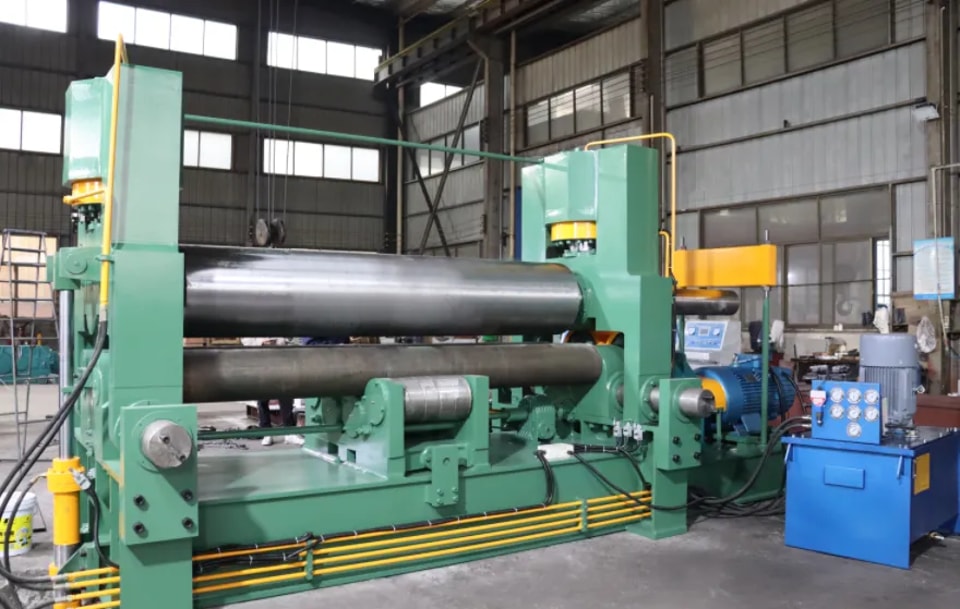
2. Working Principle of a Three-Roll Bending Machine
Core Principle: Three points form a circle.
Upper Roller: Drive roller (rotates)
Lower Roller/Side Roller: Adjusts position to form the bending radius.
Under the action of the three rollers, the thin metal sheet undergoes continuous plastic deformation, gradually forming an arc shape.
The three-roll bending machine applies continuous bending force to the metal sheet through the roller shafts, causing the sheet to gradually undergo plastic deformation. As the sheet repeatedly passes between the roller shafts, the outer fibers are stretched, and the inner fibers are compressed, ultimately forming the desired curvature.
1) Symmetrical Three-Roll Bending Machine:
l The upper roll is located in the middle, and the lower rolls are located on both sides.
l Simple structure and relatively low price.
l Suitable for general cylindrical rolling.
l Weak end pre-bending capacity, usually requiring flanging.
2) Asymmetrical Three-Roll Bending Machine:
l The positions of the upper and lower rollers are not completely symmetrical.
l Generally provides better pre-bending effect.
l Suitable for applications requiring high forming precision.
3) Fully Hydraulic or CNC Three-Roll Bending Machine:
l More stable operation and more precise control.
l It can achieve programmed adjustment, parameter memory, and automatic positioning.
l More suitable for batch and precision production.
3. Three-roll bending machine structure
1) Mechanical system
l Upper roller: Main drive
l Lower roller: Support
l Side rollers: Curvature adjustment
l Inclined frame: Unloading
l Frame: Overall load-bearing
2) Hydraulic system
l Hydraulic cylinder: Drives side rollers/lower rollers
l Hydraulic pump station
l Pressure control valve
3) Electrical control system
l PLC/CNC system
l Operation panel: Manual/Automatic
l Encoder: Position detection
4. Pre-Use Instructions
Before formal operation, operators must be clear about at least the following:
1) Sheet Metal Parameters
Must confirm:
² Material Type: Carbon steel, stainless steel, aluminum sheet, galvanized sheet, etc.
² Sheet Thickness
² Sheet Width
² Sheet Length
² Material Yield Strength
² Regardless of annealing or surface coating treatment
² Whether conical, elliptical, or other special shapes
2) Equipment Rated Capacity
Don't just look at the "maximum thickness," also consider:
² Under what material strength can the maximum rolling capacity be achieved?
² What sheet width is the maximum rolling capacity applicable to?
² Minimum rollable diameter
² Is cold rolling permitted?
² Applicable to pre-bent ends
Many users encounter problems not due to equipment damage, but because the equipment is being used beyond specifications.
For example:
Even with the same 10mm steel sheet thickness, the rolling difficulty of Q235 steel sheet and high-strength steel sheet is drastically different. Stainless steel has a more pronounced resilience than ordinary carbon steel. Although aluminum sheet is softer, it is prone to surface scratches.
3) Forming Requirements
Before starting the machine, the following must be clarified:
² What is the diameter of the finished product?
² Is it a complete circle or a partial arc?
² Do the two ends need to be butt-welded?
² Is a very high degree of roundness required?
² Is a slight elliptical error permissible?
² Is a tapered cut required?
5. Pre-Start Checklist
This step is crucial. Many equipment malfunctions and safety accidents are caused by insufficient pre-power-on checks.
1) Mechanical System Check
² Inspect each roller surface for obvious dents, cracks, weld slag, and burrs.
² Check that the roller shafts rotate freely without jamming.
² Check that the frame and anchor bolts are loose.
² Check that all fastening bolts are secure.
² Check that the guide rails, sliders, lead screws, and lifting mechanism are properly lubricated.
2) Hydraulic System Check
² Check that the hydraulic oil level is normal.
² Check that the oil is black, emulsified, or contains impurities.
² Check for leaks in hydraulic lines, joints, and cylinders.
² Check for abnormal noise from the oil pump.
² Check that the pressure is stable.
² Check that the oil temperature is within the reasonable range.
3) Electrical System Inspection
² Check if the power supply voltage is stable.
² Check if the emergency stop button is effective.
² Check if the forward and reverse rotation, lifting, and adjustment movements are normal.
² Check the inside of the control cabinet for dust, moisture, or burn marks.
² Check if all limit switches and sensors are functioning properly.
4) Safety Device Inspection
² Check if the emergency stop button is sensitive.
² Check if the protective cover is intact.
² Check if the foot switch is reliable.
² Check if the two-hand buttons are usable.
² Check for foreign objects near the upper and lower rollers.
² Check if the work area is clean.
6. Operating Procedures (Standard Steps)
The following is the generally accepted sequence of sheet metal rolling operations. The operating sequence may vary slightly depending on the equipment model, but the basic principles remain the same.
Step 1: Start the Equipment
² Connect the main power supply.
² Check that the control system is powered on correctly.
Perform a no-load slow-motion test to confirm:
² Upper roller lifting is normal.
² Side roller adjustment is normal.
² Lower roller rotation is normal.
² Forward and reverse rotation are both normal.
² Emergency stop function is effective.
Step 2: Select Appropriate Roller Positions
Adjust the positions of the upper and lower rollers according to the sheet thickness and target diameter.
The principles are as follows:
² The thicker the sheet, the larger the initial opening is usually required.
² The smaller the target diameter, the greater the bending amount.
² When pre-bending is required, the roller positions and the sheet end positions must be correctly matched.
The positioning methods differ for symmetrical and asymmetrical equipment. Please follow the equipment's operating instructions.
Step 3: Material Placement and Positioning
² Place the sheet smoothly into the equipment.
² Ensure the sheet edge is parallel to the roller.
² Align the sheet centerline with the equipment centerline.
² If using a guide device, adjust its position first.
² Prevent the sheet from entering at an angle to avoid "deviation" or "skewed rolling."
Step 4: Pre-bending before winding
This is a crucial step. When winding the sheet, the ends usually don't naturally roll to the correct position, leaving "straight edges." Therefore, it's usually necessary to pre-bend both ends.
Pre-bending point:
² First, press the end of the paper to the appropriate bending angle.
² Minimize the straight edges at the sheet ends.
² The pre-bending depth should match the target diameter.
² The pre-bending angle at both ends should be as consistent as possible. Otherwise, the finished edge will be misaligned or oval.
Step 5: Formal rolling
² Start the roller rotation.
² Slowly press down or adjust the side rollers.
² Observe the rolling status of the sheet.
² Roll back and forth multiple times if necessary.
² Gradually approach the target radius, rather than pushing it to the correct position all at once.
Step 6: Correction and Rounding
² After rolling to near the target size, fine-tuning is required:
² Check if the diameter meets requirements.
² Check if the interface gap is uniform.
² Check if the roundness is consistent.
² Check if the edges of the sheet are misaligned.
² Perform secondary rounding if necessary.
Step 7: Unloading
² Confirm that the rollers have stopped running.
² Release the pressure.
² Remove the workpiece using a crane or manual assistance.
² Large workpieces must be hoisted using appropriate lifting equipment or support frames.
² It is strictly forbidden to put your hands into the roller gap to forcibly remove the material.
7. Core Operating Techniques of Three-Roll Plate Rolling Machine
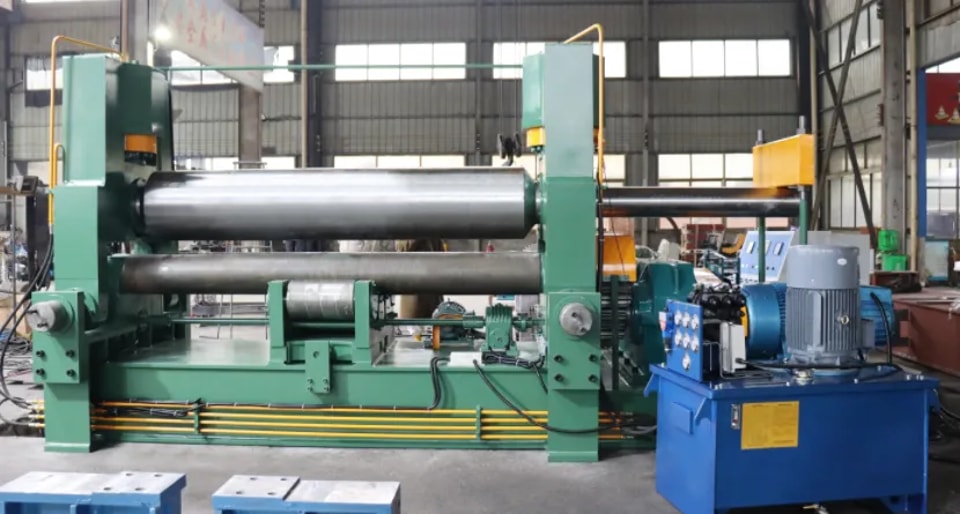
The key to effectively using a three-roll plate bending machine lies in process control, not just "being able to roll it up."
1) Controlling Pre-bending:
² Insufficient pre-bending will leave obvious straight edges.
² Excessive pre-bending will cause localized deformation, making it difficult to form a round shape, and may even result in wavy edges.
² Empirically, a comprehensive judgment should be made based on the material thickness, yield strength, roll diameter, and equipment structure.
Under most operating conditions, pre-bending should achieve the following effects:
² Shortest straight edges at both ends
² Symmetrical curvature at both ends
² Stable and consistent pre-bending amount
2) Control the feed angle
When the paper enters the roller conveyor, it should be kept:
² Parallel to the rollers
² Aligned with the center line
² No warping on the board surface
² No tilting at the board edges
If the feed angle is incorrect, the finished product will usually exhibit the following:
² Taper deviation
² One side is tight, the other is loose
² Twisted cylinder
² Uneven joints
3) Staged forming, avoid rapid pressing
Many beginners like to press multiple buttons simultaneously, which can easily lead to:
² Local over-bending
² Wrinkling of the paper surface
² Scratching of the material surface
² Increased ellipticity of the cylinder
The correct method is:
² First, press gently and observe the bending trend
² Gradually deepen the bend
² Check the results after each adjustment
² Using the "multiple small adjustments" method is more reliable
4) Pay attention to springback
² Different materials have different springback forces.
² Carbon steel has a relatively small springback force.
² Stainless steel has a larger springback force.
² High-strength steel has a more pronounced springback force.
² Due to differences in material properties, the resilience of aluminum alloys varies significantly.
Therefore, when rolling to the target diameter, not only instantaneous dimensions must be considered, but also the springback after pressure release, and over-rolling compensation may be necessary.
5) Controlling Surface Quality
If a high surface finish is required, please note the following:
² Is the roller surface clean?
² Are there weld slag or iron filings?
² Are there any hard particles trapped between the paper and the roller surface?
² Are there any marks of material clamping?
For stainless steel or aluminum sheets, it is best to avoid contact with hard objects and scratches from dirt.
Therefore, when rolling to the target diameter, not only instantaneous dimensions must be considered, but also the springback after pressure release. Over-rolling compensation may be necessary.
6) Controlling Surface Quality
If a high surface finish is required, please note the following:
² Is the roller surface clean?
² Are there any weld slag or iron filings?
² Are there any hard particles trapped between the paper and the roller surface?
² Are there any marks of material clamping?
² For stainless steel or aluminum plates, it is best to avoid contact with hard objects and scratches from dirt.
8. Key Points for Rolling Different Materials
1) Carbon Steel Plate
Characteristics:
² Good plasticity.
² Suitable for most conventional rolling processes.
² Low springback, mature technology.
Precautions:
² Pay attention to the tonnage of the equipment used for thick plate processing.
² Oxide scale on the edges can easily affect the surface.
² Pay attention to stress release in welded structural plates.
2) Stainless Steel Plate
Characteristics:
² High springback.
² Surface is easily scratched.
² Requires higher forming precision.
Precautions:
² Roller surface must be clean.
² Avoid pressing hard objects into the surface.
² Pre-bending and compensation should be more precise.
² Prevent pinching and scratching of the surface during unloading.
3) Aluminum Plate
Characteristics:
² Softer material.
² Prone to surface dents.
² Easily damaged by excessive pressure.
² Requires high-quality roll surfaces.
Precautions:
² Roller surface must be burr-free.
² Clamping force should not be excessive.
² Avoid repeated pressing.
² During transportation and hoisting, please use soft packaging for protection.
4) High-strength steel
Characteristics:
² High yield strength.
² Requires greater forming force.
² Significant springback.
² Easily increases equipment load.
Precautions:
² Do not exceed specifications.
² The rated capacity of the equipment must be checked.
² The rolling process should be smoother and slower.
² The hydraulic and drive systems of the equipment bear greater loads, requiring close monitoring of temperature rise and pressure.
9. Key Points for Machining Conical, Arc-Shaped, and Special Workpieces
1) Conical Rolling
Conical rolling is more complex than circular rolling because the circumferences at both ends are different, requiring the metal sheet to be rolled into a cone shape.
Key Points:
² The sheet metal feed angle must be offset according to the taper requirements.
² The feed amounts on both sides of the metal sheet must be different.
² A conical rolling device or special tools are required.
² The dimensions of the large and small ends need to be determined first.
² The longer the cone and the smaller the cone angle, the more critical the control becomes.
2) Arc Rolling
If only a partial arc is needed, rather than a complete circle:
² Set the target bending radius.
² Control the roll-in length.
² Form in segments multiple times.
² Maintain consistent arc length.
3) Large-Diameter Sheets
Larger-diameter sheets are prone to the following:
² Wrinkles
² Wavy edges
² Instability
² Uneven formation
Solutions:
² Reduce the amount of bending per pass
² Increase material support
² Control the flatness of the sheet surface
² Use a gentler, multi-stage rolling method
10. Common Problems and Solutions
1) Excessively Large Straight Edges at Both Ends
Cause:
² Insufficient pre-bending
Solution:
² Increase pre-bending amount
² Use "secondary pre-bending"
2) Uneven Perimeter, Large Ovality
Cause:
² Uneven roller position adjustment
² Improper paper feeding
² Uneven pressure on both sides
² Insufficient rolling time
² Large difference in material rebound force
Solution:
² Correct left-right balance of the equipment
² Adjust the center line
² Add a rounding process
² Compensate for over-rolling of the material
3) Sheet Deviation
Cause:
² Sheet misalignment
² Roller parallelism error
² Guide device not adjusted
² Sheet edge not straight
Solution:
² Readjust
² Refer to the guide
² Correct roller parallelism
² Trim the sheet edge
4) Conical Shape
Cause:
² Sheet misalignment
Solution :
² Readjust
² Adjust side roller pressure difference
5) Surface scratches
Causes:
² Foreign objects on the roller surface
² Wear or scratches on the roller surface
² Particles embedded in the sheet surface
² Over-clamping
Solutions:
² Clean the roller surface
² Grind or repair the roller surface
² Strengthen protection for materials with high surface requirements
² Reduce unnecessary contact pressure
6) Paper slippage
Causes:
² Insufficient pressure
² Surface oil stains
Solutions:
² Increase clamping force
² Clean the sheets
7) Slow or weak hydraulic action
Causes:
² Insufficient hydraulic oil
² Pump wear
² Abnormal system pressure
² Oil circuit blockage
² Excessively high oil temperature
Solutions:
² Check the oil level
² Replace the filter element
² Check the pump and valves
² Clean the oil circuit
² Control the continuous high load operation time
11. Maintenance Guide (Key Points)
1) Daily Maintenance:
² Clean the roller surface.
² Inspect the oil lines.
² Inspect fasteners.
² Lubricate the guide rails.
2) Hydraulic System:
² Change the hydraulic oil every 2000 hours.
² Clean the filter element regularly.
² Check for oil leaks.
3) Mechanical Components:
² Inspect roller wear.
² Inspect bearing temperature.
² Ensure proper roller parallelism.
4) Electrical System:
² Inspect wiring.
² Back up PLC parameters.
² Calibrate the encoder.
12. Routine Maintenance
Maintenance is crucial for the long-term stable operation of a three-roll bending machine.
1) Routine Maintenance
² Clean the equipment surface, roller surface, and working area.
² Check for oil leaks, electrical leaks, and loose parts.
² Remove sheet metal chips, metal shavings, and welding slag.
² Check that lubrication points are functioning properly.
² Run the three-roll bending machine under no-load conditions to confirm smooth operation.
2) Weekly Maintenance
² Check fasteners.
² Check the lubrication of rollers, guide rails, chains, or gears.
² Check hydraulic lines and joints.
² Observe changes in oil temperature and noise.
² Check the smoothness of major movements.
3) Monthly Maintenance
² Check the hydraulic oil contamination level.
² Check the condition of the filter element.
² Check the electrical wiring terminals.
² Check limit switches and sensors.
² Check the equipment level and foundation condition.
4) Periodic Overhaul
² Replace the hydraulic oil.
² Change the screening elements.
² Check bearing wear.
² Check roller surface accuracy.
² Check the pressure reducing valve oil.
² Perform accuracy calibration if necessary.
13. Lubrication Requirements
Lubrication is one of the key factors for the long-term stable operation of a three-roll plate bending machine.
Lubrication Points:
² Roller bearings
² Guide rails
² Lead screws
² Gears
² Chains
² Lifting mechanism
² Other mechanical connections
Lubrication Principle:
² Operate according to the lubricating oil and lubrication cycle specified in the instruction manual.
² Do not mix greases unsuitable for different parts.
² Use lubricant in moderation; excessive lubricant can attract dust.
² Increase the frequency of inspections under high temperature and high load conditions.
14. Safe Operating Procedures
The three-roll plate bending machine is a heavy-duty forming machine; safety must be the primary consideration.
Principles to be followed:
² Operators must be trained.
² Do not wear loose clothing, scarves, or gloves near rotating parts.
² Do not put your hands into the gaps between the rollers.
² Ensure the equipment is completely stopped before unloading.
² Large workpieces must be hoisted.
² If abnormal noise, vibration, oil leakage, or odor is detected, stop the three-roll plate bending machine immediately.
² Before performing any maintenance, the power must be disconnected, pressure released, and warning signs posted.
Special Note:
² No one should stand on the side where the workpiece may tip over while the equipment is running.
² When rolling large-diameter workpieces, prevent injury from rolling.
² Adequate support must be provided when rolling conical parts and extra-long plates.
² Any overload may damage the rollers, cylinders, and reducer.
15. Operational Experience and Recommendations
These experiences are extremely useful in actual production.
Trial Production Before Mass Production:
For new processes, materials, and dimensions, roll a test piece to confirm the parameters before mass production.
Beware of Rebound. Don't Just Look at Machine Dimensions:
The actual dimensions after decompression are the true dimensions.
Be More Conservative When Using Thick Steel Plates and High-Strength Steel:
Reducing the rolling speed and increasing the frequency of pressure application ensures the safety of both the equipment and the workpiece.
Cleanliness During Operation is Crucial. Workpieces Requiring High Surface Finish:
Even a small piece of metal shaving can leave a noticeable scratch on the surface.
Establish Suspension Devices for Lifting Auxiliary Equipment:
Large cylinders are extremely dangerous if they lose balance.
Ensure Even Force Distribution:
Uneven force distribution on one side often leads to elliptical or twisted shapes.
Contact Us