
What Is Metal Plate Rolling Machine? [ Definition & Working Principle ]
2026-05-30

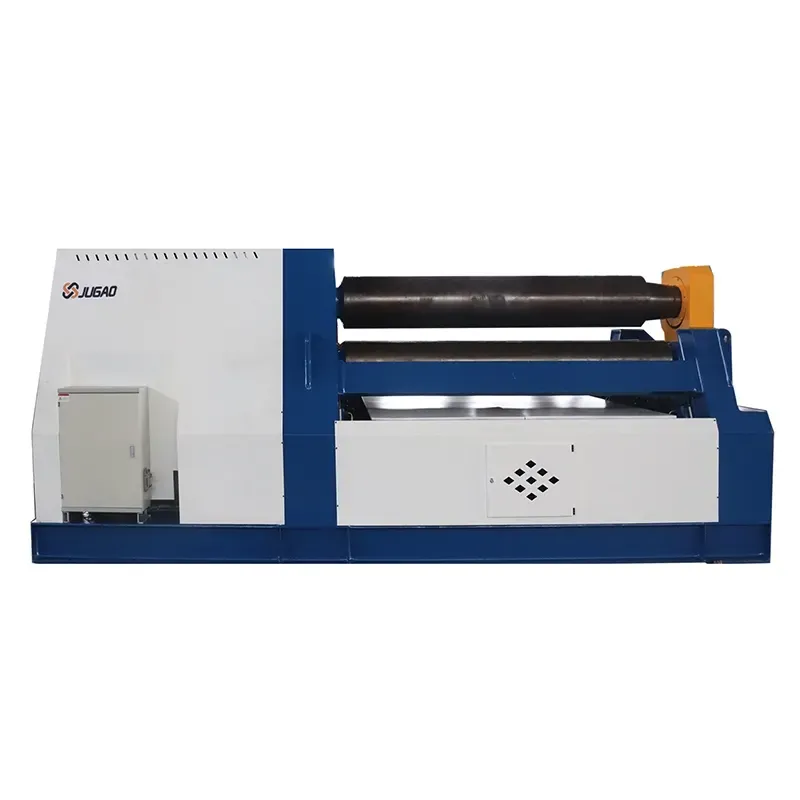
What is a metal sheet rolling machine? A metal sheet rolling machine is a processing device that rolls metal sheets into circles, arcs, or other shapes. It applies pressure to the metal sheet through the rotation and relative motion of rollers, causing it to gradually undergo plastic deformation, ultimately forming the desired arc or curved surface. Rolling machines are widely used in the manufacture of pressure vessels, pipes, boilers, fan housings, aerospace components, and other fields.
1. What is a metal sheet rolling machine?
1) Definition of a plate rolling machine:
The main steps include:
– Sheet positioning: Place the metal sheet between the rollers of the plate rolling machine.
Clamping and pre-bending: The upper roller applies downward pressure to clamp the sheet metal and pre-bends the edges to reduce the length of the straight edges after forming.
– Edge forming: By rotating the rollers and adjusting the pressure, the sheet material is gradually bent into the required arc or curved surface.
– Unloading: After rolling is complete, loosen the rollers and remove the finished product.
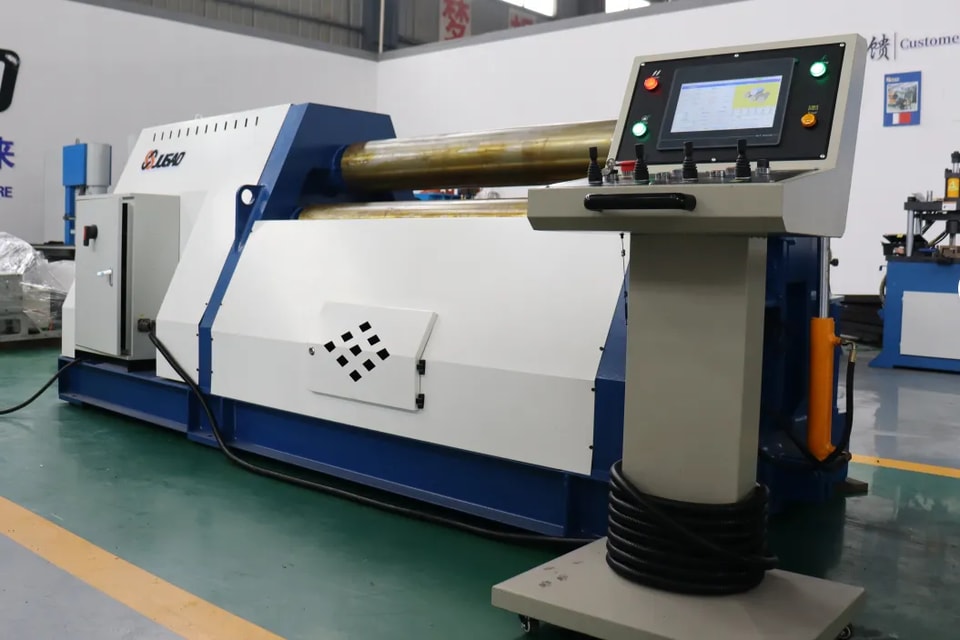
2. Plate rolling machine Main components
Roller system:
It typically consists of an upper roller, a lower roller, and side rollers, responsible for clamping and curling the sheet metal. The rollers are usually made of high-strength alloy steel, which is wear-resistant and hard.
Drive system:
Provides the rotational power for the rollers. Mechanical types use gear transmission, while hydraulic and servo types use hydraulic cylinders or motors for drive.
Hydraulic system:
Used to control the lifting and lowering of the rollers and adjust the pressure, ensuring the accuracy and stability of the processing.
Control system:
It includes manual control and CNC systems. The CNC system can preset machining parameters to achieve automated operation.
Base and frame:
It supports the entire equipment, ensuring its stability and accuracy during operation.
3. Working principle of plate rolling machine
A bending machine uses rollers to apply pressure and rotate a metal sheet, causing the sheet to undergo plastic deformation and gradually bend it into the desired shape (such as a cylinder, cone, or arc).
What is the working principle of a metal sheet rolling machine? This process is achieved by adjusting the relative position of the rollers and using power drive. The working principle will be analyzed in detail below.
1) Basic Workflow
A plate rolling machine typically consists of an upper roller and a lower roller (or side rollers). The sheet metal is gradually shaped by clamping, rotating, and bending between the rollers. The specific steps are as follows:
- Clamping plate
Place the sheet material between the rollers, and apply downward (or upward) pressure with the upper roller (or lower roller) to clamp the sheet material and prevent it from sliding.
- Pre-bending treatment
To reduce the straight edge length of the board, the plate rolling machine performs a preliminary bending (called pre-bending) on both ends of the board.
The initial rounded shape of the edge of the sheet material is achieved by adjusting the pressure and position of the rollers.
- Bending roll forming
The rollers begin to rotate, causing the sheet material to move while it is clamped. As the sheet material passes between the rollers, it gradually undergoes plastic bending to form the target curvature.
- Adjustment and correction
If necessary, the curvature or shape can be further optimized by adjusting the pressure and position of the rollers.
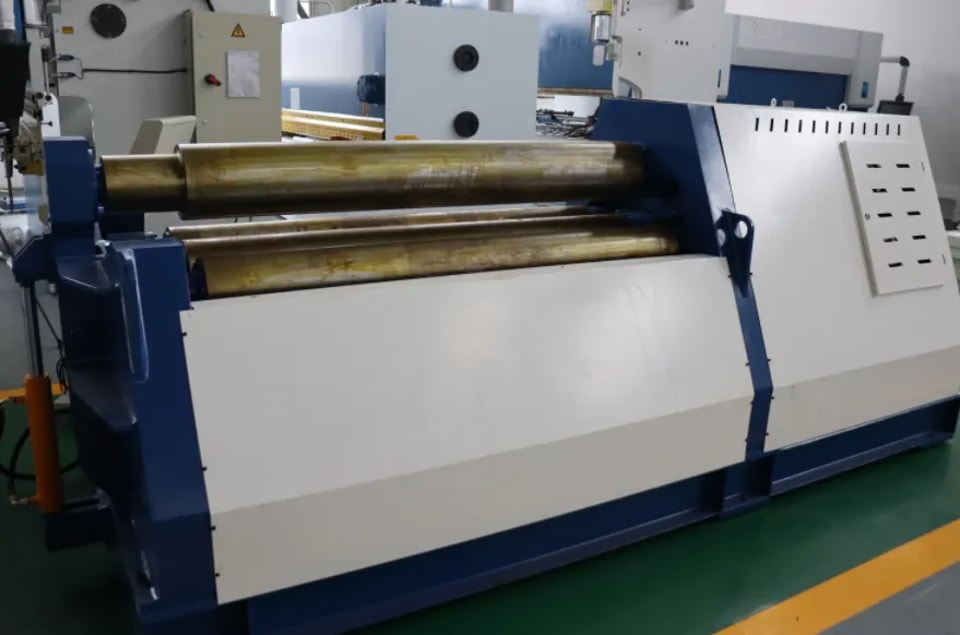
This four-roll plate bending machine can achieve more accurate correction with the assistance of side rollers.
- Finished product unloading
After rolling is complete, loosen the rollers and remove the processed product from the rolling machine.
2) Working principles of plate rolling machines with different structures
- Three-roll symmetrical plate rolling machine
Structural features:
The upper roller is symmetrically installed between the two lower rollers. The upper roller can move vertically, while the two lower rollers rotate, driving the sheet material to move.
Working principle:
The sheet material is pressed down by the upper roller and clamped by the lower roller.
The rotation of the lower roller causes the sheet to move, while the upper roller applies a bending force to the sheet.
The sheet material is repeatedly bent by the rotation of the lower roller, and finally shaped.
feature:
The structure is simple, but the edges of the sheet material cannot be pre-bent directly.
- Three-roll asymmetric plate rolling machine
Structural features:
The upper roller is the main roller, one lower roller is used to clamp the sheet metal, and another lower roller is used to assist in bending.
Working principle:
After the sheet material is clamped, the edges are pre-bent by adjusting the position of the rollers.
The upper roller rotates, causing the sheet material to move while simultaneously applying a bending force.
The relative motion between the rollers gradually forms the target arc.
feature:
It can be pre-bent, making it suitable for high-precision machining.
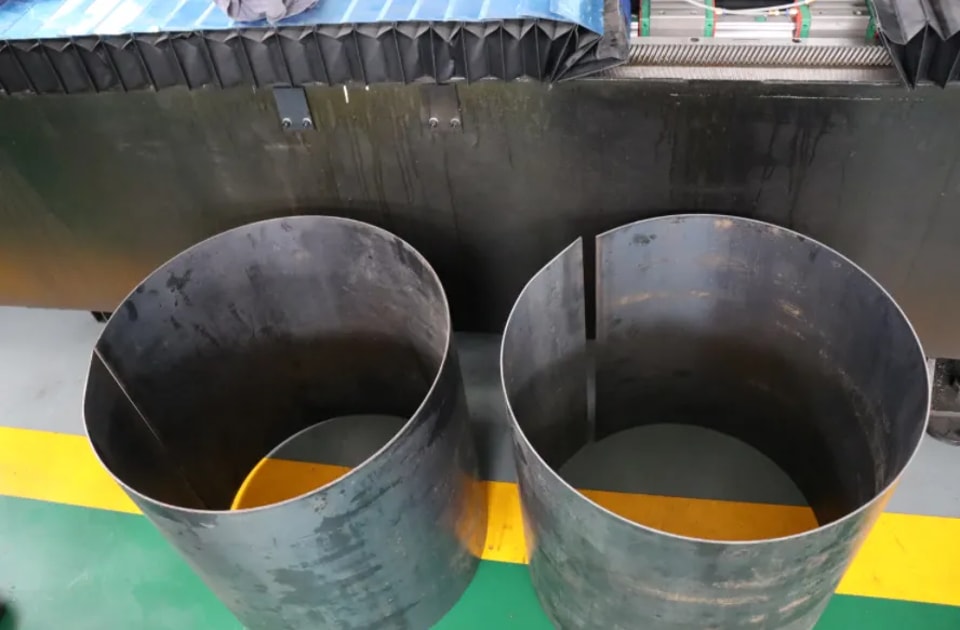
- Four-roll plate bending machine
Structural features:
One upper roller, one lower roller, and two side rollers, the side rollers being used to clamp and straighten the sheet metal.
Working principle:
The sheet metal is clamped by upper and lower rollers, and side rollers are used for positioning.
The upper roller applies a bending force, causing the sheet material to move.
Side rollers further correct the bending shape of the sheet material.
feature:
It is easy to operate, highly accurate, and can complete pre-bending and winding in one go.
3) Key physical principles
The working principle of a metal sheet rolling machine is based on the principle of plastic deformation of metal. Specifically, it includes:
The effect of bending force:
When the bending force applied by the roller exceeds the yield strength of the metal material, the metal sheet will undergo plastic deformation. By gradually applying force, the sheet is bent from a flat state into the target shape.
Control of elastic rebound:
During the bending process, the sheet metal will have a certain elastic rebound. The plate rolling machine compensates for the rebound by applying additional bending force to ensure the accuracy of the finished product's arc.
Multiple molding processes:
For thicker or harder boards, repeated bending is required to gradually achieve the desired shape.
4. Application areas of metal sheet rolling machines
What are the applications of metal sheet rolling machines? Details are as follows:
Application industries:
– Pressure vessel manufacturing: rolling cylindrical or curved shells for large containers such as boilers and storage tanks.
Pipe processing: Manufacturing large-diameter pipes or ventilation ducts.
– Shipbuilding: Processing the curved surfaces of ship hull plates.
– Aerospace: Manufacturing curved or cylindrical components for aircraft, rockets and other equipment.
– Building construction: Rolled steel structural components for building construction, such as columns, curved beams, etc.
Application example:
– Manufacturing cylindrical storage tanks: The tank shell is formed by continuously bending metal plates.
– Processing tapered tubes: Use a tapered plate rolling machine to gradually reduce the diameter of the plate.
– Constructing steel structures for buildings: such as curved beams or cylindrical support structures for bridges.
5. Conclusion
Plate rolling machines use the rotation and pressure of rollers to gradually bend metal sheets into a target shape. Their core principle is to utilize the plastic deformation properties of metal, combined with a precise control system, to achieve efficient and accurate bending processes. Different types of plate rolling machines are suitable for different materials and shape requirements, providing vital support for modern manufacturing.
What is a metal rolling machine? A rolling machine is one of the essential pieces of equipment in modern metal processing. Through continuous development and technological upgrades, it has become a core tool for efficient and high-precision bending processes. Whether traditional mechanical equipment or modern CNC rolling machines, they provide crucial support for metal forming and processing across various industries.
Contact Us