


Selection of Shielding Gas in Laser Welding
2026-05-29

Have you encountered welding defects such as excessive spatter, unsightly weld formation, and numerous pores after welding? While you might be wondering if it's due to incorrect laser welding process parameter settings, are you aware that the correct use of shielding gas is also a crucial factor affecting weld formation and performance? Choosing the optimal shielding gas is actually a way to improve welding quality and efficiency.
Since shielding gas is so important, what exactly is its function? How should you choose the type of shielding gas? How should the shielding gas be blown in during welding?
The Role of Shielding Gas
In laser welding, the shielding gas affects weld formation, weld quality, weld penetration, and weld width. In most cases, blowing in shielding gas has a positive impact on the weld, but it can also have adverse effects.
Positive Effects
1) Properly introduced shielding gas effectively protects the weld pool, reducing or even preventing oxidation.
2) Properly introduced shielding gas effectively reduces spatter during welding.
3) Properly introduced shielding gas promotes uniform spread of the weld pool during solidification, resulting in a uniform and aesthetically pleasing weld.
4) Properly introduced shielding gas effectively reduces the shielding effect of metal vapor plumes or plasma clouds on the laser, increasing the effective utilization rate of the laser.
5) Properly introduced shielding gas effectively reduces weld porosity.
As long as the gas type, gas flow rate, and introduction method are selected correctly, ideal results can be achieved.
However, improper use of shielding gas can also negatively impact welding.
1) Incorrect shielding gas application may worsen the weld:
① Choosing the wrong gas type may cause weld cracks and reduce weld mechanical properties;
② Choosing the wrong gas flow rate may lead to more severe weld oxidation (whether the flow rate is too high or too low), and may also cause severe interference to the weld pool, resulting in weld collapse or uneven formation;
③ Choosing the wrong gas application method may result in ineffective or even nonexistent shielding, or negatively affect weld formation;
2) Shielding gas application can affect weld penetration, especially in thin-plate welding, reducing weld penetration.
Types of Shielding Gases
Commonly used laser welding shielding gases include N2, Ar, and He. Their physicochemical properties differ, and therefore their effects on the weld vary.
Nitrogen (N2)
The cheapest, but unsuitable for welding certain stainless steels. Nitrogen (N2) has a moderate ionization energy, higher than Ar but lower than He. Under laser irradiation, its ionization degree is generally low, effectively reducing plasma cloud formation and thus increasing the effective utilization rate of the laser. However, nitrogen can react chemically with aluminum alloys and carbon steel at certain temperatures, producing nitrides. This increases weld brittleness and reduces toughness, significantly negatively impacting the mechanical properties of the weld joint. Therefore, nitrogen is not recommended for protecting aluminum alloy and carbon steel welds.
On the other hand, the nitrides produced by the chemical reaction of nitrogen with stainless steel can increase the strength of the weld joint, improving its mechanical properties. Therefore, nitrogen can be used as a shielding gas when welding stainless steel.
Argon (Ar)
is relatively inexpensive, has a high density, and provides good protection. The weld surface is smoother than with helium. However, it is easily ionized by high-temperature metal plasma, which can shield part of the laser beam from reaching the workpiece, reducing the effective welding power and hindering welding speed and penetration. Ar (Ar) has the lowest ionization energy, but its ionization degree is relatively high under laser irradiation, which is not conducive to controlling the formation of plasma clouds and will have a certain impact on the effective utilization rate of the laser. However, Ar has very low reactivity and is difficult to chemically react with common metals. Furthermore, Ar is inexpensive. In addition, Ar has a high density, which facilitates its settling above the weld pool, providing better protection for the weld pool. Therefore, it can be used as a conventional shielding gas.
Helium (He)
It is more expensive, but has the best effect, allowing the laser to pass directly through without obstruction to the workpiece surface. He has the highest ionization energy, but its ionization degree is very low under laser irradiation, which can effectively control the formation of plasma clouds. The laser can act well on metals, and He has very low reactivity, basically not chemically reacting with metals. It is an excellent shielding gas for welds. However, He is too expensive, and it is generally not used for mass production. He is generally used for scientific research or high-value-added products.
Shielding Gas Injection Methods
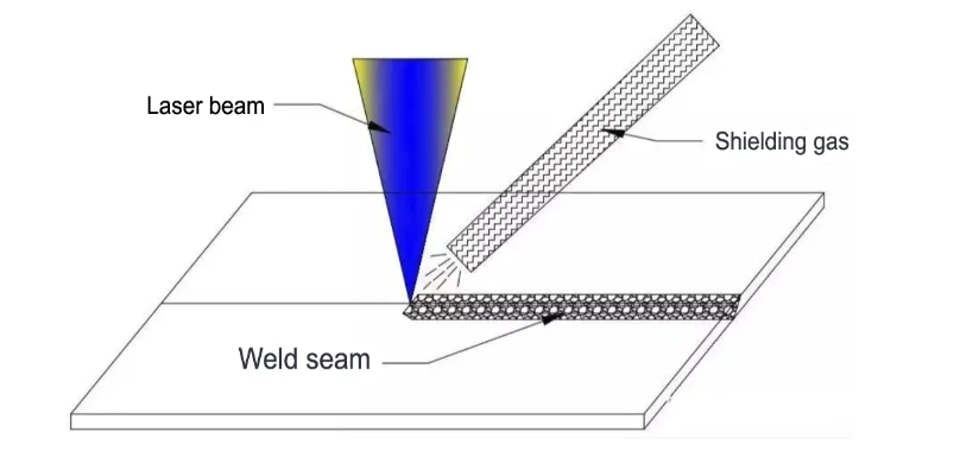
There are currently two main methods for introducing shielding gases: one is off-axis side-blowing of shielding gas...Parallel side-blown protective gas
Another type is coaxial protective gas.
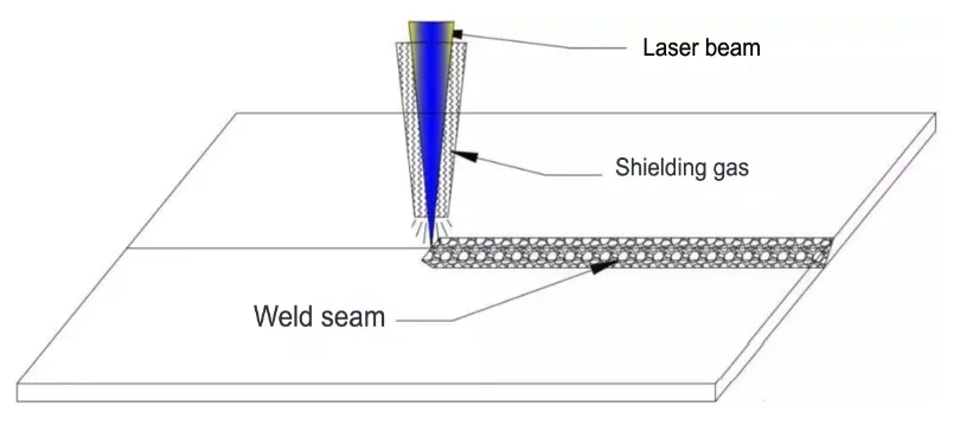
Coaxial Shielding Gas
The choice between the two blowing methods depends on a combination of factors, but side-blowing shielding gas is generally recommended.
Principles for Choosing Shielding Gas Blowing Methods
First, it's important to clarify that the term "weld oxidation" is a colloquial expression. Theoretically, it refers to a chemical reaction between the weld and harmful components in the air, leading to a deterioration in weld quality. Common examples include the weld metal reacting with oxygen, nitrogen, and hydrogen in the air at certain temperatures.
Preventing weld oxidation involves reducing or avoiding contact between these harmful components and the weld metal at high temperatures. This high temperature refers not only to the molten pool metal but also to the entire period from when the weld metal melts until it solidifies and its temperature drops below a certain level.
For example, in titanium alloy welding, hydrogen is rapidly absorbed above 300°C, oxygen above 450°C, and nitrogen above 600°C. Therefore, titanium alloy welds require effective protection after solidification and during the period when the temperature drops below 300°C; otherwise, they will be "oxidized."
As the above description clarifies, the blown shielding gas not only needs to protect the weld pool in a timely manner but also the newly solidified area. Therefore, the off-axis side-blowing shielding gas method shown in Figure 1 is generally used because it offers a wider protection range than the coaxial protection method shown in Figure 2, especially providing better protection for the newly solidified weld area.
For engineering applications, off-axis side-blowing shielding gas is not suitable for all products. For certain specific products, only coaxial shielding gas can be used. The choice must be tailored to the product structure and joint type.
Specific Shielding Gas Blowing Method Selection
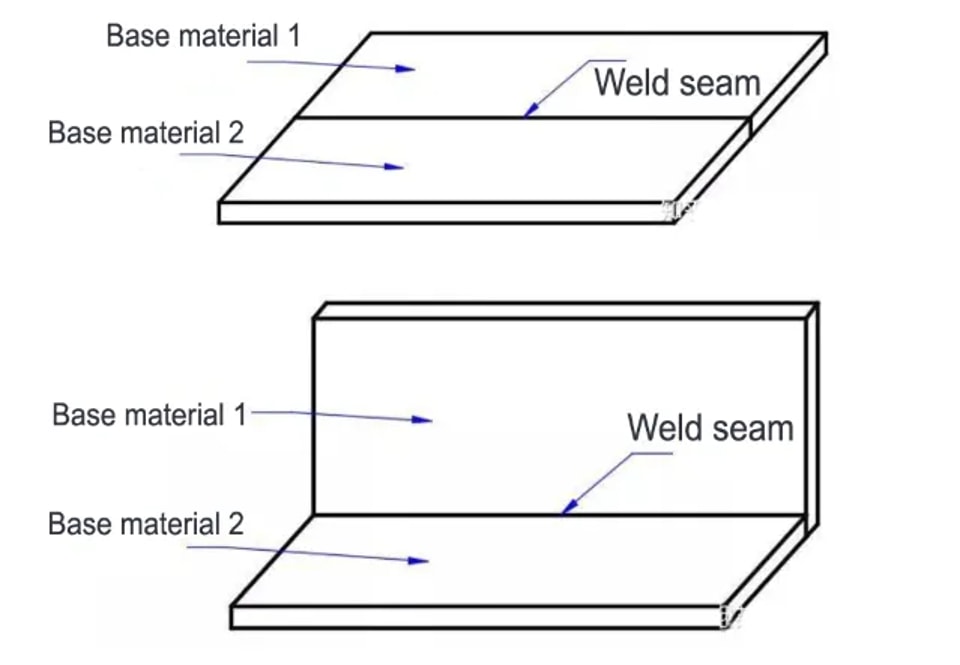
1) Straight Welds
As shown in Figure 3, the weld shape of the product is straight. The joint type can be a butt joint, lap joint, corner joint, or overlapping weld. For this type of product, the off-axis side-blowing shielding gas method shown in is preferred.
2) Planar Closed-Shaped Welds
The weld shape of the product is a closed shape such as a planar circle, a planar polygon, or a planar multi-segment line. The joint type can be a butt joint, a lap joint, or an overlap weld joint. For this type of product, coaxial shielding gas is preferred.
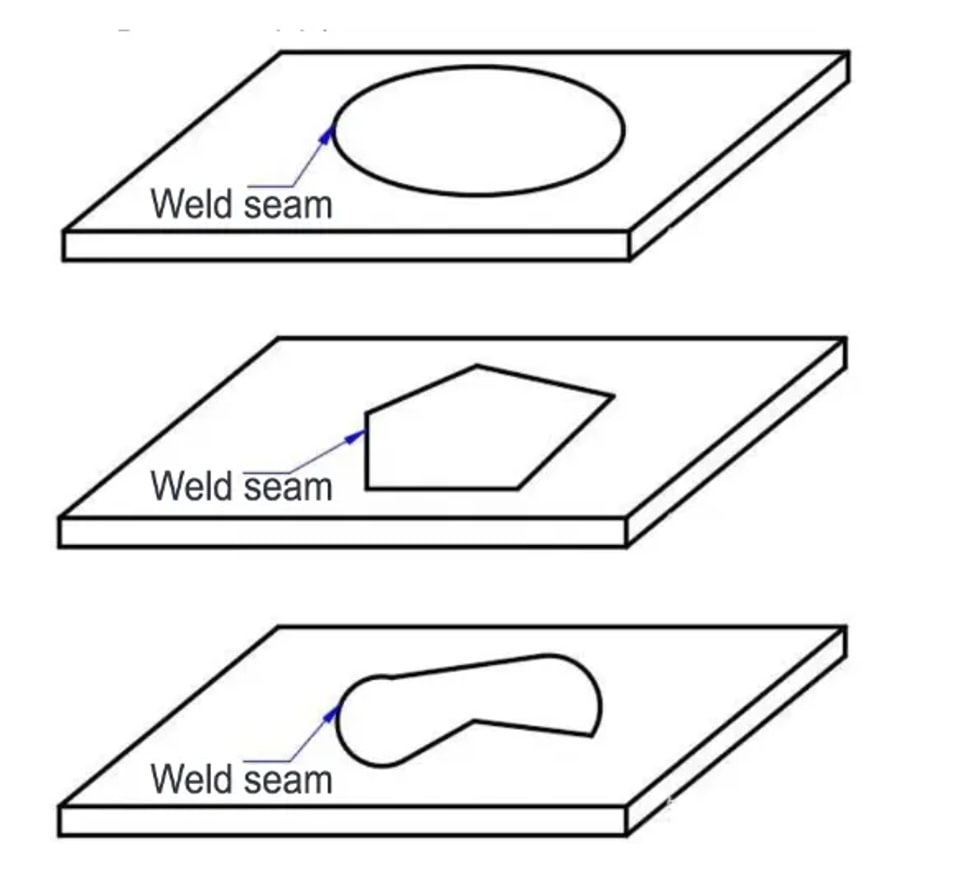
Planar closed-shape weld
The selection of shielding gas directly affects the quality, efficiency, and cost of welding production. However, due to the diversity of welding materials, the selection of welding gas in actual welding is quite complex. It is necessary to comprehensively consider the welding material, welding method, welding position, and required welding effect. Only through welding testing can a more suitable welding gas be selected to achieve better welding results.
Contact Us