
Replacement Frequency of Welding Robot Contact Tips
2026-04-16

Just like manual welding, welding robots require frequent contact tip replacements. In fact, because robots operate for longer periods than human welders, the replacement frequency is even higher.
The contact tip is one of the most frequently replaced consumable parts in welding. It serves to fix the position of the welding wire as it passes through. Due to the large current surge at the end of welding, the outlet of the contact tip can easily melt, causing the welding wire and the contact tip to fuse together, rendering the welding impossible. The material and workmanship of the contact tip determine its lifespan.
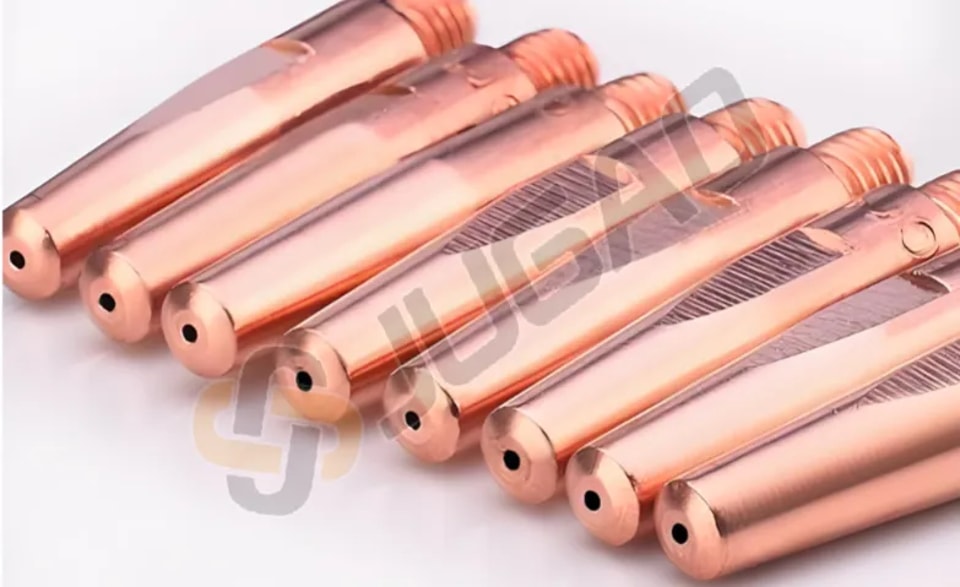
Most contact tips are made of brass, copper, chromium copper, and, less commonly, beryllium copper. Copper is the most commonly used material in manual welding, while chromium copper is superior to copper, being more durable and the most commonly used material in robotic welding. Besides becoming unusable due to fusion with the welding wire, another reason for a contact tip to become unusable is that over time, the aperture becomes too large for the welding wire, making it unable to properly fix the wire's exit position. Manual welding is somewhat tolerable, but because robots weld according to pre-programmed procedures, issues like weld misalignment and uneven welds can occur if the hole diameter is too large. Therefore, the contact tip needs to be replaced if the hole diameter becomes too large. Generally, for low currents below 150A, it is recommended to replace the contact tip every 48 hours. For high currents above 180A, the contact tip should be replaced every 12 hours. Of course, the specific replacement time depends on how much the hole diameter has been worn down.
Contact Us