

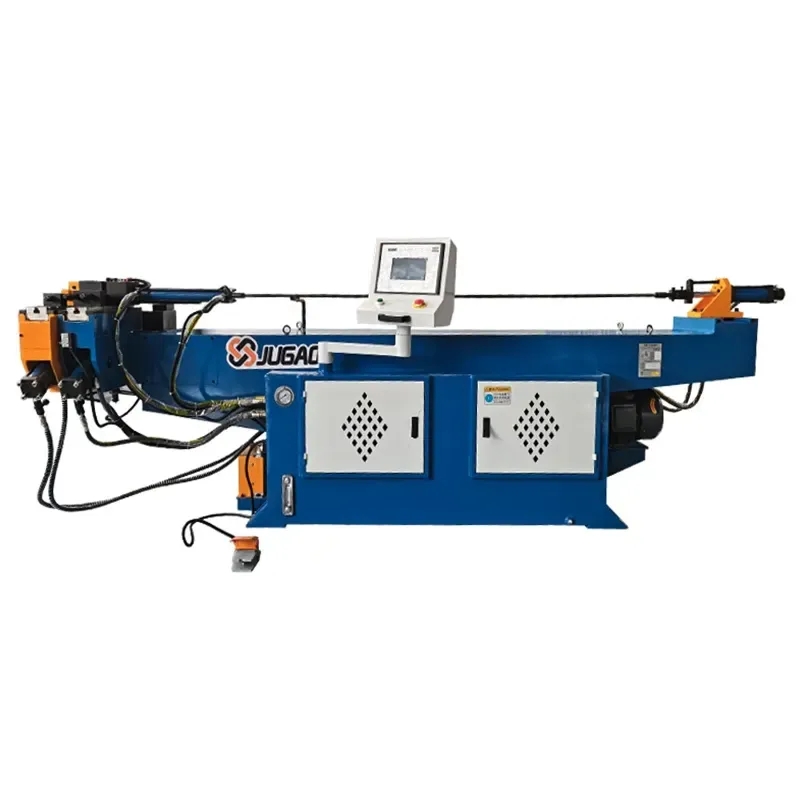
Pipe Bending Machine Temperature Control: Ignoring These Points Will Produce Only Waste Products
2026-05-26

Spending time in the workshop, you'll notice a strange phenomenon: the same pipe bending machine works perfectly in the summer, but problems arise in winter—pipes crack, angles become unstable, and surfaces wrinkle. Many people spend a lot of time adjusting programs and changing molds, but the problem actually lies in temperature.
Temperature may seem insignificant, but its impact on pipe bending quality is far greater than you imagine. Below, I'll break down the three most critical temperature-influencing factors in detail.
I. Low Pipe Temperature: Cracking Upon Bending
This is a common problem in winter. Carbon steel, stainless steel, and even some aluminum alloys experience a significant decrease in plasticity at low temperatures. The elongation of metallic materials decreases with decreasing temperature; simply put, they become "brittle."
When bending a pipe, the outer side is under tension, resulting in the greatest deformation. If the pipe material is already brittle, microcracks will appear after stretching to a certain extent. In mild cases, a dense layer of tiny cracks will appear on the outer surface of the bend; in severe cases, the pipe will crack through, rendering it unusable.
How low is low? Generally, caution is advised when the pipe temperature is below 10℃. For stainless steel, the risk of cracking increases significantly when bending below 5℃.
What to do?
In winter, transport the pipes to the workshop a day in advance to allow them to warm up; do not put them directly on the machine after leaving them outdoors frozen overnight.
If you are in a hurry, use a heater (hot air gun, oven) to heat the pipes to above 15℃ before bending them. Make sure to heat evenly, not just on one side.
For high-strength steel and thick-walled pipes, it is recommended to preheat to 20-25℃.
A real example: Last winter, a customer called saying that his stainless steel pipes kept cracking when bending. I asked him where he stored the pipes, and he said in the open-air storage yard, where they were dried directly in the morning at -3 degrees Celsius. I told him to put them in the workshop for a day and try again. The next day, he called to say that they were fine, and not a single one had cracked.
II. Incorrect Hydraulic Oil Temperature: Unstable Angle
Hydraulic oil is the lifeblood of a pipe bending machine; its temperature directly affects the system's response speed and pressure stability.
**Insufficient Oil Temperature (below 15℃):** The hydraulic oil viscosity is too high, resulting in poor fluidity. The bending arm's movement becomes sluggish, discontinuous, or even "creeping"—moving a bit and then stopping. This leads to uneven compression of the pipe's inner surface, easily causing wavy wrinkles. Furthermore, at low oil temperatures, system pressure builds up slowly, bending force is unstable, and the angle fluctuates.
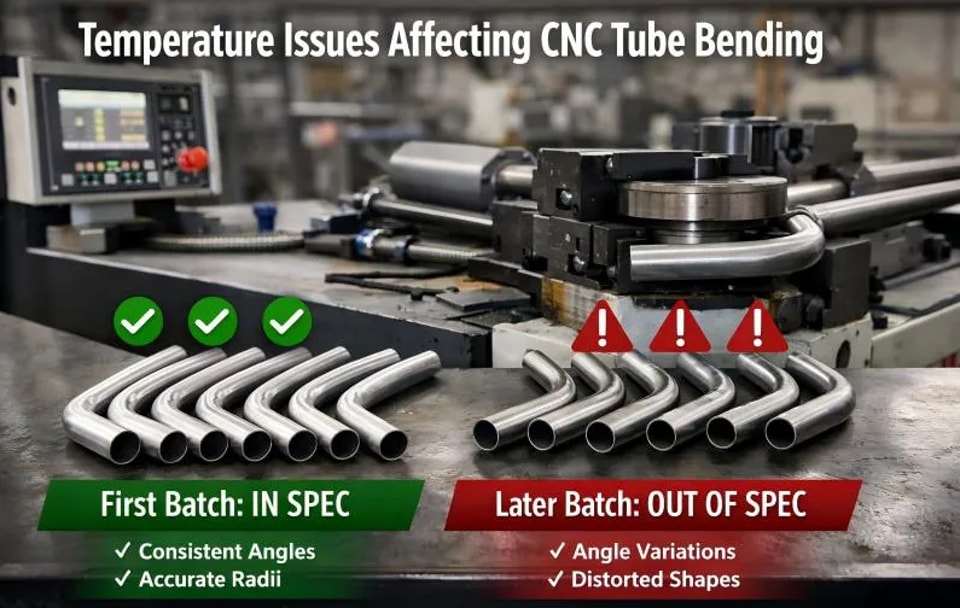
**Insufficient Oil Temperature (above 55℃):** The oil becomes thinner, viscosity decreases, and internal leakage increases. Oil that should be pushing the cylinder leaks through gaps, reducing the actual pressure reaching the bending arm. The result is: a program set to 90 degrees may only produce an 87-degree bend, and the rebound of each pipe will be inconsistent, resulting in uneven angles. Prolonged high temperatures also accelerate seal aging, leading to further oil leaks.
Ideal Range: 35℃-50℃ Within this range, hydraulic oil has good fluidity, stable pressure, and a long seal life.
How to control the temperature?
After starting the machine, run it unloaded for 5-10 minutes to allow the oil temperature to rise slowly. Don't start it up immediately.
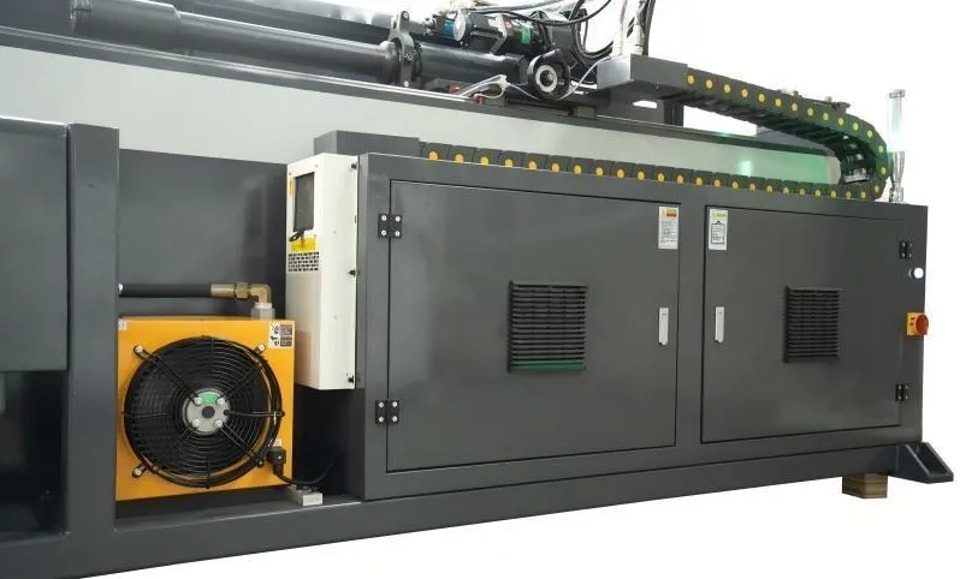
When working continuously, monitor the oil temperature gauge. If it exceeds 50℃, turn on the oil cooler or cooling fan.
In winter, if it's too cold, you can add a heating rod to the oil tank (be careful, don't let it dry out).
If the oil temperature remains consistently high, check if the cooler is clogged or if the fan is not working.
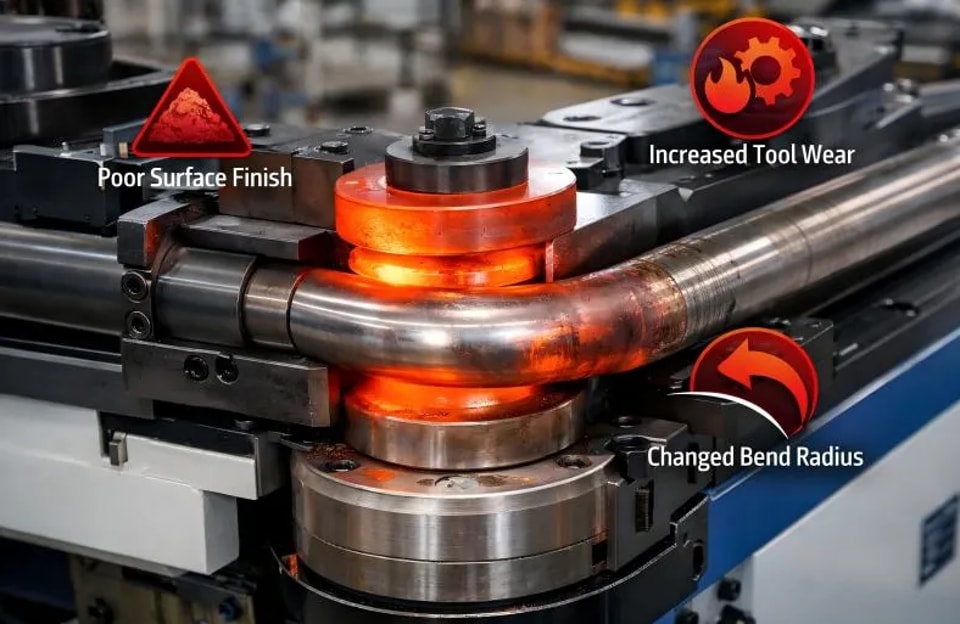
III. Overheating Due to Friction Between the Die and the Pipe: Surface Scratching and Wrinkling
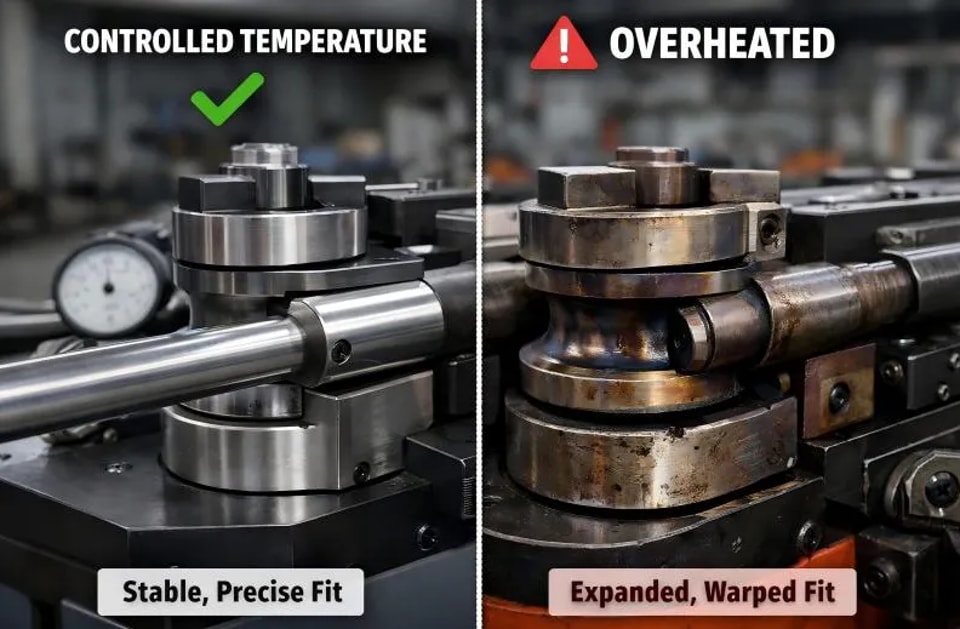
Many people are unaware of this. During high-speed continuous pipe bending, the intense friction between the pipe and the die can cause localized temperatures to soar above 100°C.
High temperatures cause three problems:
First, the bending oil film is destroyed. Special bending oils contain extreme pressure additives that form an oil film under high pressure to separate the metal surfaces. At high temperatures, this oil film ruptures, allowing direct metal-to-metal contact and resulting in wide scratches on the pipe surface.
Second, the die surface material softens. Some die steels harden at high temperatures, causing metal shavings from the pipe to adhere to the die, forming built-up edge. This built-up edge is hard and sharp, further scratching subsequent pipe sections.
Third, localized softening of the pipe. If the temperature in the pressure zone inside the pipe is too high, the material softens and cannot withstand the compressive force, directly forming large wrinkles.
How to avoid this?
Don't press the cycle too hard. After bending dozens of pipes consecutively, let the machine rest for a few minutes to allow the mold to cool down.
Use high-temperature resistant special bending oil; don't use ordinary machine oil.
Clean the mold surface regularly, and promptly grind away any built-up edges.
For mass production, consider installing a micro-cooling device (air cooling or oil mist cooling).
IV. Special Process: Induction Heating Bending
Some factories use induction heating to assist in bending pipes. The pipe is locally heated before bending, which reduces bending force and prevents cracking. However, this technology requires very precise temperature control.
If the temperature is too high (exceeding the material's recrystallization temperature), the inner side of the pipe softens excessively, causing large wrinkles under pressure; the outer wall thickness thins drastically, potentially leading to cracking. If the temperature is too low, it fails to provide the necessary assistance.
Correct Practice: An infrared thermometer must be used to monitor the temperature in real time, with upper and lower limit alarms set. The heating temperature and speed must be matched; do not bend the pipe based on guesswork ("bend it when it's red-hot").
A Practical Temperature Management Checklist
Before starting the machine each day: Check the oil temperature gauge; preheat in cold weather.
Bending pipes in winter: Allow the pipes to warm up in the workshop for 24 hours, or preheat to above 15°C.
During continuous production: Check the oil temperature every half hour; if it exceeds 50°C, start cooling.
If you hear abnormal friction noises or see surface scratches: Stop the machine and check the mold temperature and lubrication.
If the oil temperature remains too high for an extended period: Schedule maintenance of the cooling system and replace the hydraulic oil.
Temperature is the hidden killer of pipe bending quality. Pipes will crack if they get too cold, the angle will deviate if the oil temperature is incorrect, and overheating due to friction will cause scratches and wrinkles. Controlling these three factors can reduce the scrap rate by at least half. Don't think it's too much trouble; it's more effective than adjusting the program a hundred times.
Contact Us