
What Should You Verify on an Enclosed Exchange Table Fiber Laser Cutter?
2026-10-03

Choose the complete cutting cell
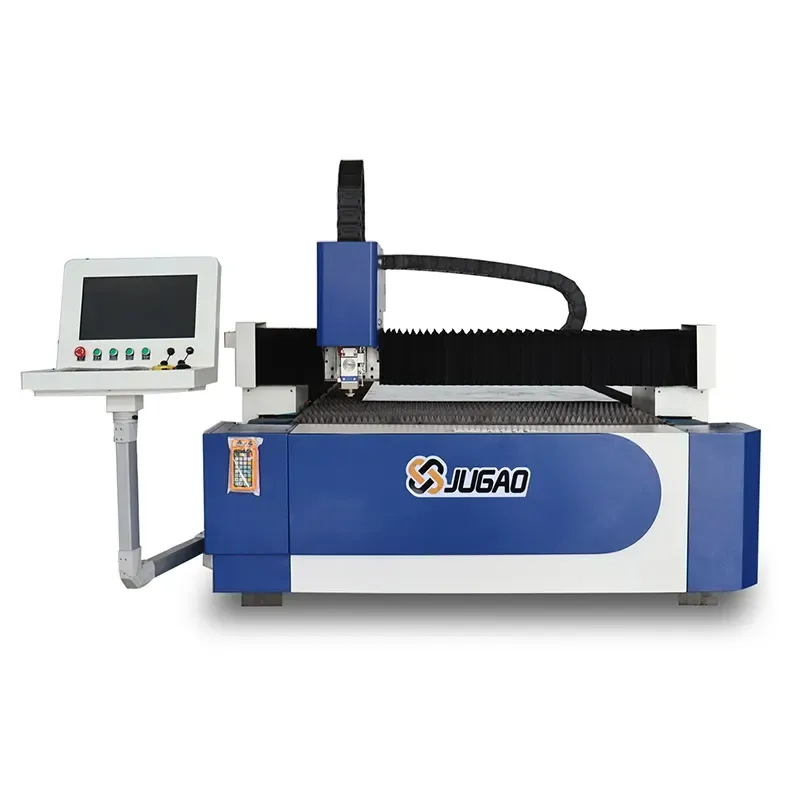
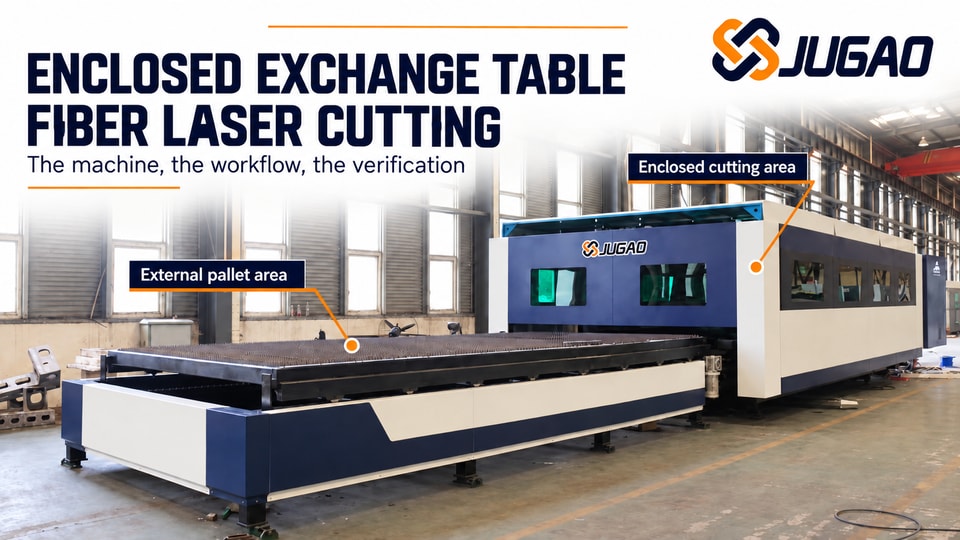
An enclosed exchange-table fiber laser cutter combines a protected cutting area with alternating pallets so external unloading and loading can overlap with cutting. Start with your actual materials, drawings, edge requirements and shift target. Then verify both-table loading, measured exchange time, guarding, extraction, utilities and acceptance evidence. JUGAO lists the automatic table exchanger, cover and segmented smoke exhaust as options on its ER3015-2000W page; confirm the integrated configuration in a signed specification.
- Can the selected process make the required part?
- Can handling overlap enough to improve output?
- Can the cell protect people in every operating state?
- Can the factory support and verify the complete configuration?
Define the machine you are ordering
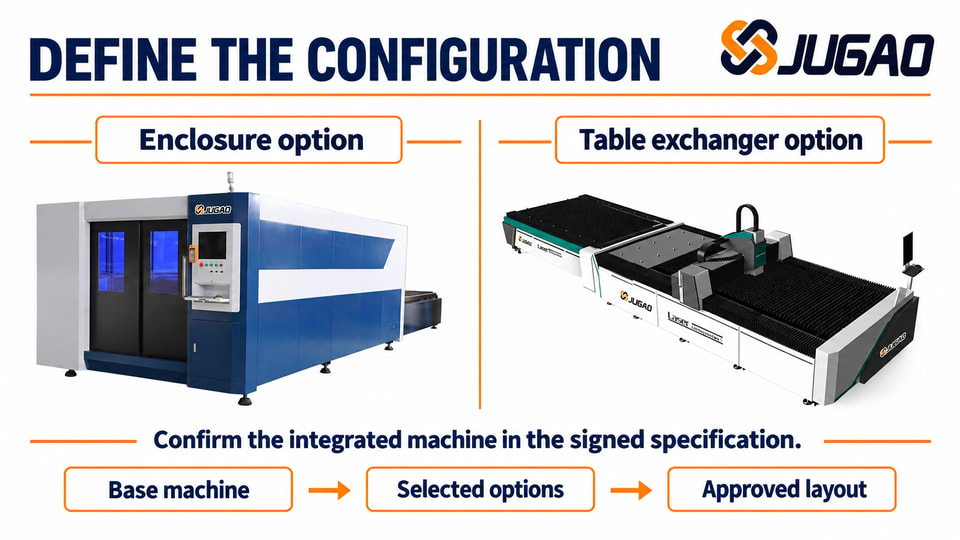
An enclosure and a second pallet solve different engineering problems. The enclosure forms part of the radiation, splash and fume-control design; the exchanger changes the material-handling sequence. A two-pallet system does not by itself include sheet storage, automatic loading, finished-part sorting or unattended recovery. Identify the complete model, configuration revision and included options before comparing quotes. Treat each opening, service door and pallet transfer point as part of the cell design.
| Configuration | What changes | What still needs confirmation |
|---|---|---|
| Open, single table | One handling/cutting position | Process, exposure controls and safe access |
| Open, exchange table | External handling can overlap | External motion and radiation protection |
| Enclosed, single table | Protected cutting zone | Door states, windows and extraction |
| Enclosed, exchange table | Enclosure plus alternating pallets | Complete integrated safety and load/cycle specification |
Measure the whole handling sequence
Read the machine as a sequence of controlled states. The external pallet is a working position: unloading, skeleton removal, slat cleaning, loading and locating all consume time. A sheet with many small parts may take longer to sort than to cut. Confirm how tipped parts, warped sheets and incomplete unloading are detected and recovered before the next exchange. Operators need a defined safe place during motion, together with a clear restart procedure after an interruption.
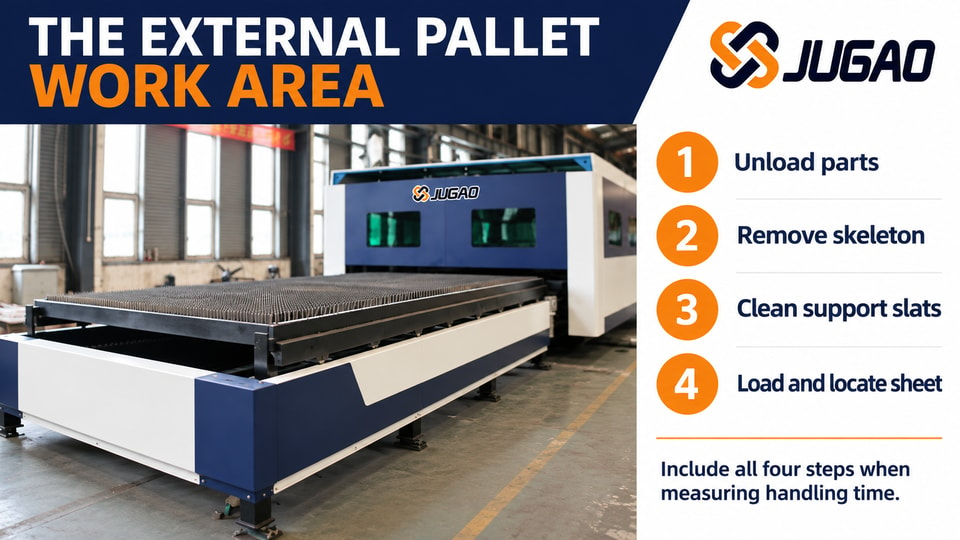
- Cut: program, pierce, contour and internal rapid moves occupy the cutting zone.
- Handle: unload parts, remove skeleton, clean, load and locate the next sheet.
- Exchange: transfer, confirm position/locking and reach the ready-to-cut state.
- Recover: address alarms under the approved isolation and reset procedures.
Read public values with their boundaries
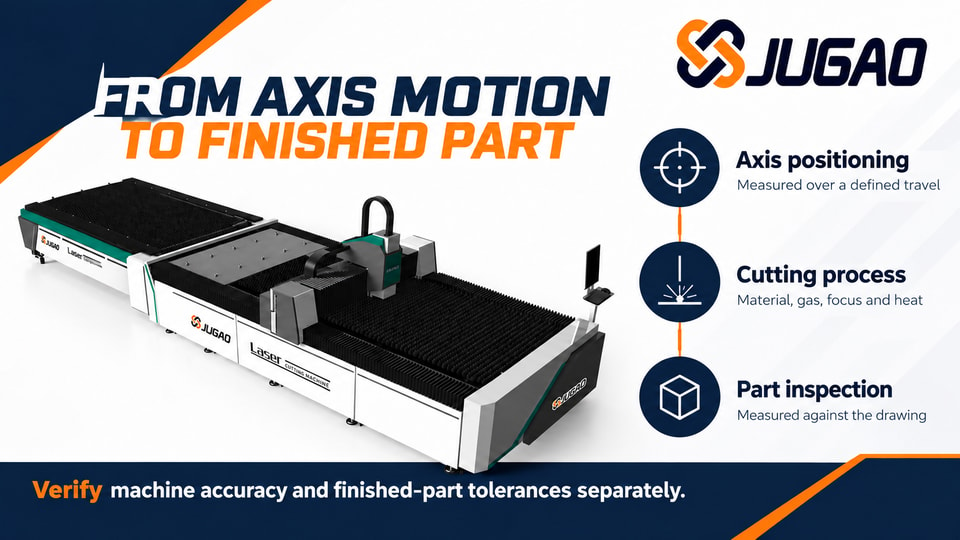
JUGAO’s public base-machine specifications provide a starting point for quote review. Axis positioning and repeatability describe machine motion under defined test conditions; finished-part tolerance also depends on kerf, heat, fixturing, nesting and inspection. Ask for the test travel, temperature, load and method when reviewing axis results. The installed laser, cutting head, controller and auxiliary equipment must be identified by exact model and revision in the final supply list.
| ER3015-2000W public field | Published value | Interpretation |
|---|---|---|
| Working area / laser output | 3000 × 1500 mm / 2000 W | Base-machine page values |
| Laser / cooling / transmission | MAX / water cooling / gear + rails | Confirm installed models and interfaces |
| X/Y positioning / repeatability | ±0.02 mm / ±0.02 mm | Test conditions are not stated; not part tolerance |
| Maximum X/Y movement / acceleration | 120 m/min / 1.5 G | Not cutting feed or sheet output |
| Drive powers | Y 1500 W; X1/X2 1000 W each; Z 400 W | Not total connected load or operating consumption |
| Gross weight | 4500 kg | Integrated enclosure/exchanger scope unconfirmed |
| Table exchanger / cover / segmented extraction | Listed options | Confirm inclusion in the signed order |
| Pallet load, exchange time, footprint, laser class | Order-level confirmation required | Obtain installed-cell drawings and evidence |
Calculate when two tables actually help
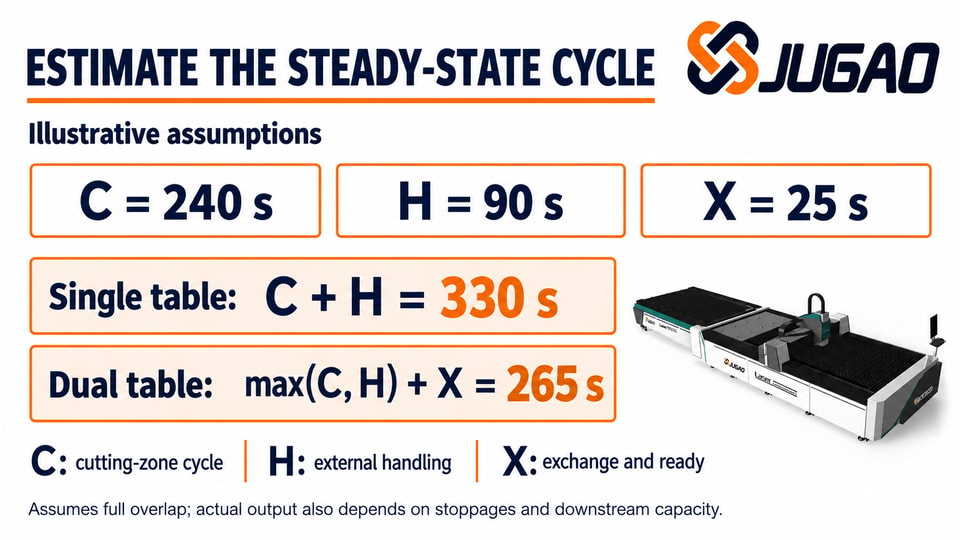
Let C be cutting-zone occupation including piercing and programmed internal moves, H external unloading/cleaning/loading/locating, and X the complete exchange until the next table is ready to cut. In stable alternating production, with fully overlapping external handling, the ideal dual-table cycle is max(C,H) + X. Under this simplified comparison the exchanger saves time only when X < min(C,H). First-piece checks, interruptions, supply dips and downstream queues reduce the practical gain.
| Hypothetical C / H / X | Single | Dual | Cycle change | Ideal sheets/h: single → dual |
|---|---|---|---|---|
| 240 / 90 / 25 s | 330 s | 265 s | 19.7% shorter | 10.9 → 13.6 |
| 60 / 90 / 25 s | 150 s | 115 s | 23.3% shorter | 24.0 → 31.3 |
| 240 / 20 / 25 s | 260 s | 265 s | 1.9% longer | 13.8 → 13.6 |
Calculate sheet mass before specifying pallet capacity
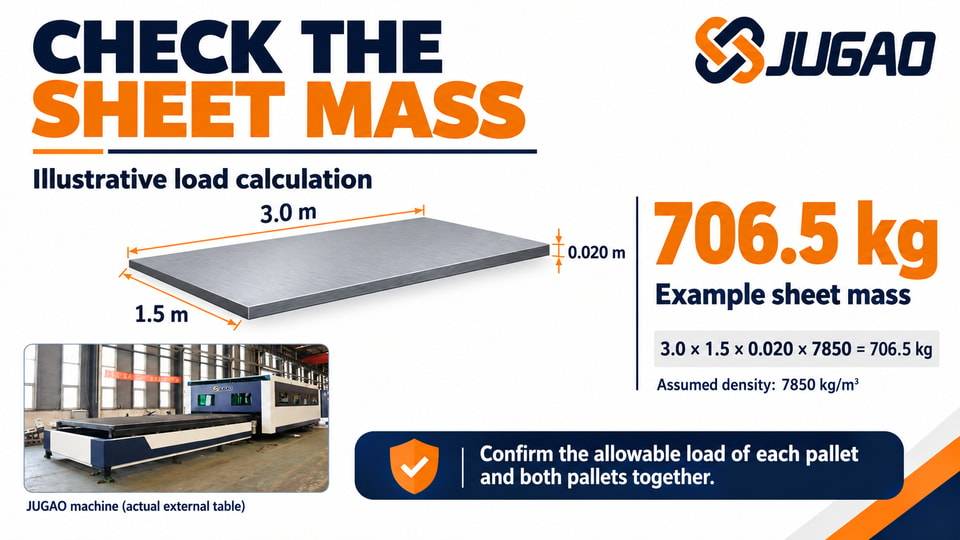
Pallet capacity needs two definitions: the permitted load on each table and the permitted combined loading condition. Use material density and actual dimensions to screen the heaviest job, then confirm distributed/concentrated loads, retained scrap and the manufacturer’s load definition. Sheet mass alone cannot establish moving-table capacity, lifting-equipment selection or floor support loads. Request the approved loading rules and support-point reactions for the installed cell.
Match materials and geometry to a validated process
The intended application is two-dimensional profiling of metal sheet. Carbon steel, suitable stainless grades, aluminum and copper alloys need separate confirmation by alloy, thickness, surface condition, geometry and required edge. High reflectivity, coatings, closely spaced holes, narrow webs and long slender parts change the process and handling risks. Tube cutting requires its own configuration; a sheet-cutting option list does not establish capability for tubes, nonmetals or composite materials.

| Job characteristic | Question for the trial |
|---|---|
| Material grade and surface | Does the installed source/head support this alloy and surface condition? |
| Thickness distribution | Can common jobs meet quality and cycle targets, not just pierce through? |
| Small holes, corners and dense nests | Are hole geometry, heat accumulation and part tipping acceptable? |
| Welding, coating or visible edges | What oxide removal, deburring or surface preparation follows cutting? |
Choose assist gas around the edge requirement
Oxygen supports oxidation cutting; nitrogen or argon can expel melt while limiting edge oxidation in a suitable fusion-cutting process. Compressed air may be viable where the validated material/process combination allows it. Decide from the required edge and downstream work, then specify dynamic supply performance. Compressor nameplate pressure alone does not establish pressure and flow at the cutting process during demand peaks.
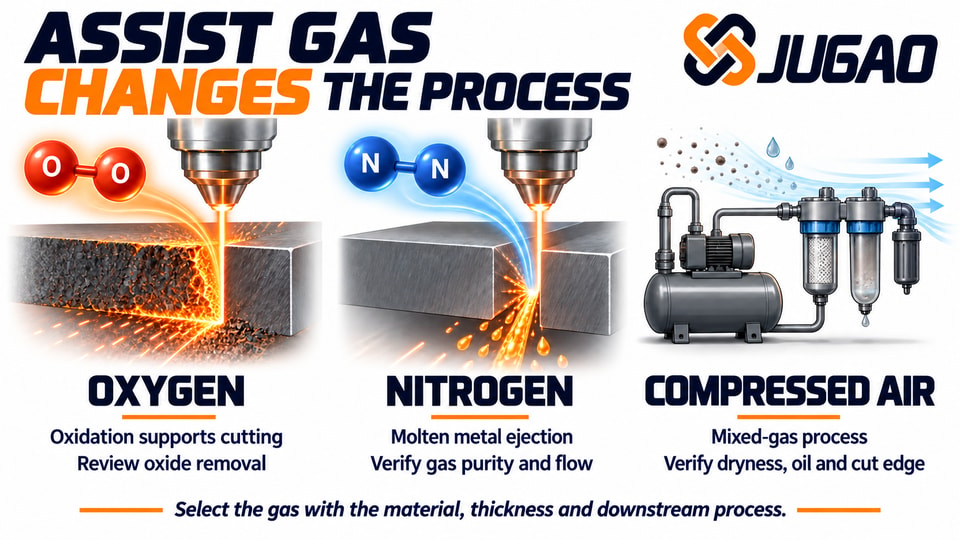
| Gas/process | Engineering purpose | Confirm in the trial |
|---|---|---|
| O₂ / oxidation cutting | Oxidation contributes energy | Oxide layer, heat effect, piercing and downstream preparation |
| N₂ or Ar / fusion cutting | Expel melt with an inert gas | Dross, discoloration, purity, dynamic flow and finished edge |
| Compressed air | Alternative for validated applications | Pressure, moisture/oil control, dew point and edge acceptance |
Accept finished parts against the drawing
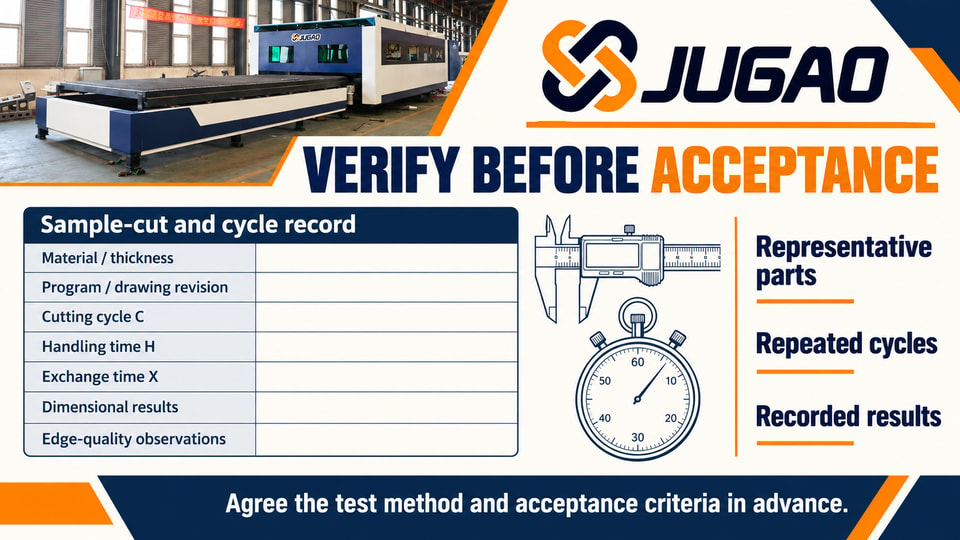
A successful cut must satisfy the drawing and the next operation. Record dimensions and hole locations, edge angle, roughness, dross, discoloration, distortion and surface damage. ISO 9013 provides a thermal-cut quality classification framework; its scope does not establish the cutting capacity of a JUGAO model. Specify which characteristics are to be measured, where measurements are taken, the instrument and the agreed acceptance limits before the sample run.
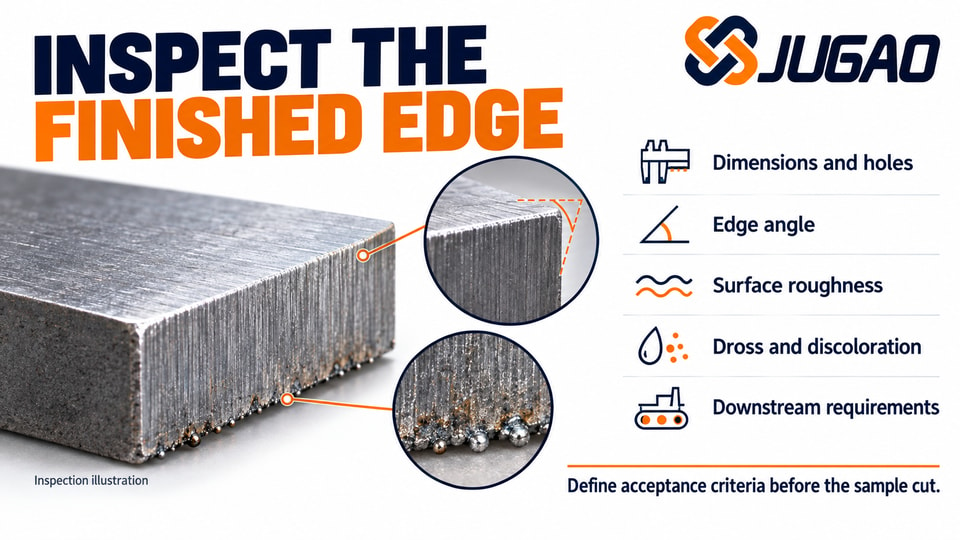
- Record material grade/batch, measured thickness and drawing/program revision.
- Log power, gas, nozzle, focus, piercing settings and cycle boundaries.
- Measure representative holes, long dimensions and thermally sensitive features.
- Record accepted, reworked and rejected pieces, together with downstream edge preparation.
Verify enclosure, openings and exchange-zone protection
An enclosure does not establish Class 1 classification. Obtain evidence for the installed wavelength and power, enclosure seams/openings, viewing windows, doors and emission-stop behavior. Review access during pallet movement, crush points, restart and recovery after power or air loss. The required safety functions and performance follow the machine risk assessment. A standards reference supports the review method; it is not proof that a particular configuration has passed testing or meets every installation jurisdiction.
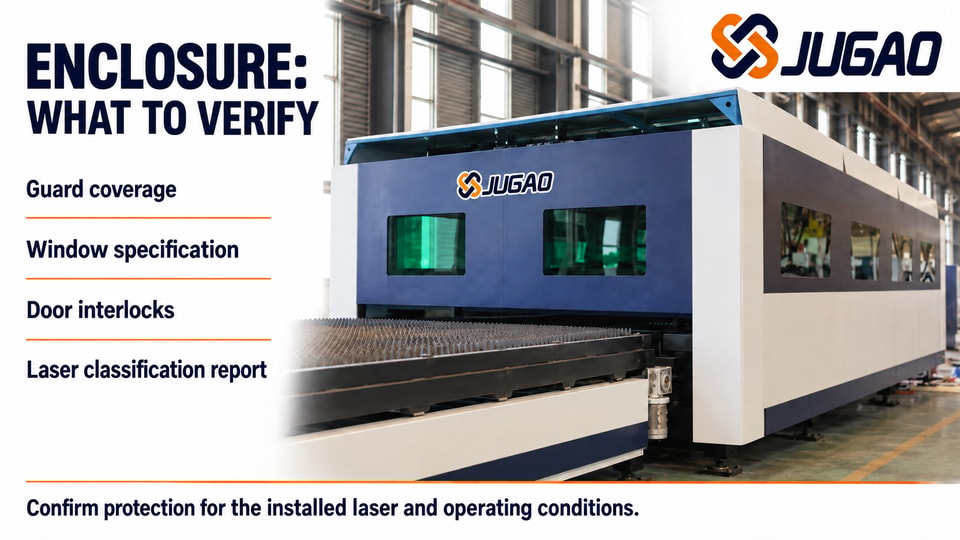
| Verification subject | Evidence to request | Primary reference |
|---|---|---|
| Laser classification and radiation protection | Installed classification, guard/window suitability and tests | IEC 60825-1:2014; IEC 60825-4:2022; ISO 11553-1:2020 |
| Doors, service openings and reset | Interlock design, defeat resistance and validated safety functions | ISO 14119:2024; ISO 13849-1:2023 |
| External exchanger | Guarding/access limits, overload/locking states and safe recovery | OSHA 1910.212 — machine guarding |
| Maintenance | Machine-specific hazardous-energy isolation procedure | OSHA 1910.147 — hazardous energy |
Design extraction for the actual material
The enclosure helps contain the process, while extraction must capture fume at its source and move it through an appropriate collection and discharge system. Specify zone operation, design airflow, working static pressure, filter condition monitoring, duct route and response to extraction failure. Evaluate the actual metals, coatings, sparks and slag. Fire response and cleaning access belong in the cell design, including safe disposal and filter-service procedures.
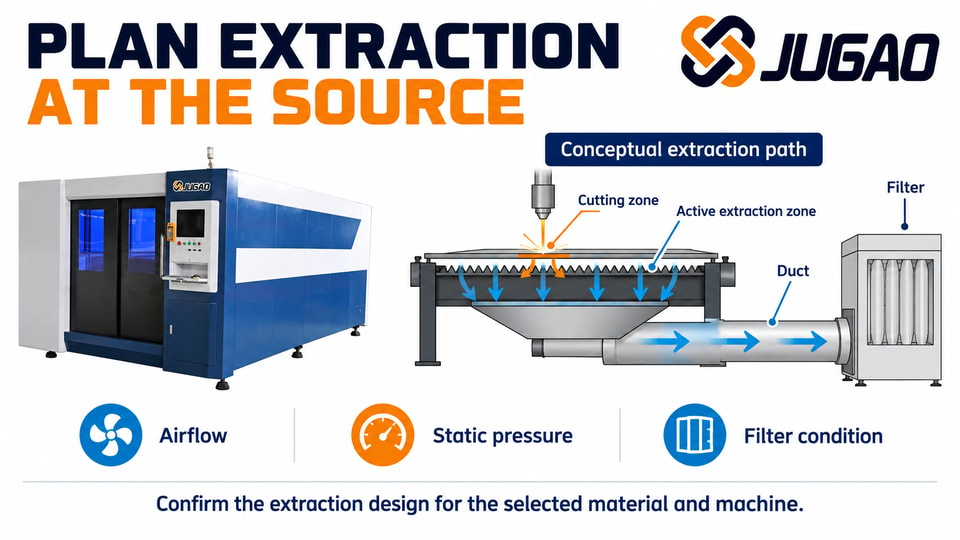
- At the cut: establish capture and the active extraction zone.
- In the system: check duct losses, filter condition and available fan performance.
- At the outlet: establish the approved discharge/exposure-control arrangement.
- On failure: document alarm, stop/recovery and maintenance responsibilities.
Plan the complete installation envelope
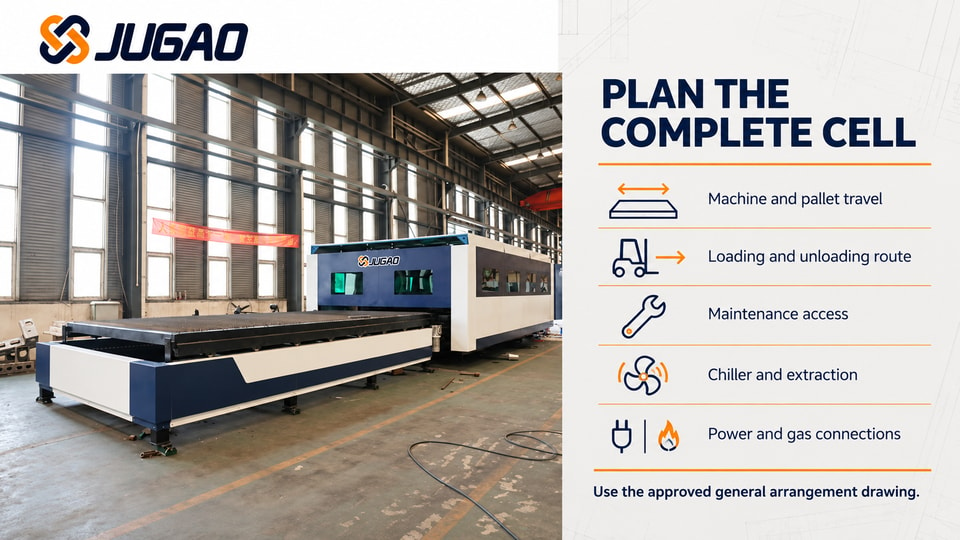
“3015” is a nominal sheet-size designation, not the overall machine footprint. Request a general-arrangement drawing covering both pallets in motion, door opening, loading and lifting routes, maintenance space, chiller and extraction equipment. Confirm total mass, support-point reactions, foundation requirements, electrical supply and grounding, cooling environment and gas connections. Site services must sustain the process during production; a base-machine weight or laser output value cannot size the whole installation.
| Site input | Required definition |
|---|---|
| Layout, mm | Machine + pallet travel + service and handling clearances |
| Structure, kg / force units as specified | Total installed mass, support reactions and foundation design |
| Power, V / Hz / kW | Supply, protection, grounding and total connected demand |
| Gas, bar / Nm³/h | Dynamic pressure/flow, purity, dew point and simultaneous demand |
| Cooling and extraction | Ambient limits, cooling capacity, airflow/static pressure and interfaces |
Maintain the components that control consistency
Optical cleanliness, nozzle condition, slat condition, drive lubrication and filtration affect repeatable production. Define inspection and replacement tasks from the machine and component manuals, with access arrangements and required spares. A protected cutting cell still needs routine attention. Isolate hazardous energy before servicing under the approved procedure; an emergency stop is not a substitute for energy isolation. Include safe fault recovery, operator training and records of recurring alarms in the handover.
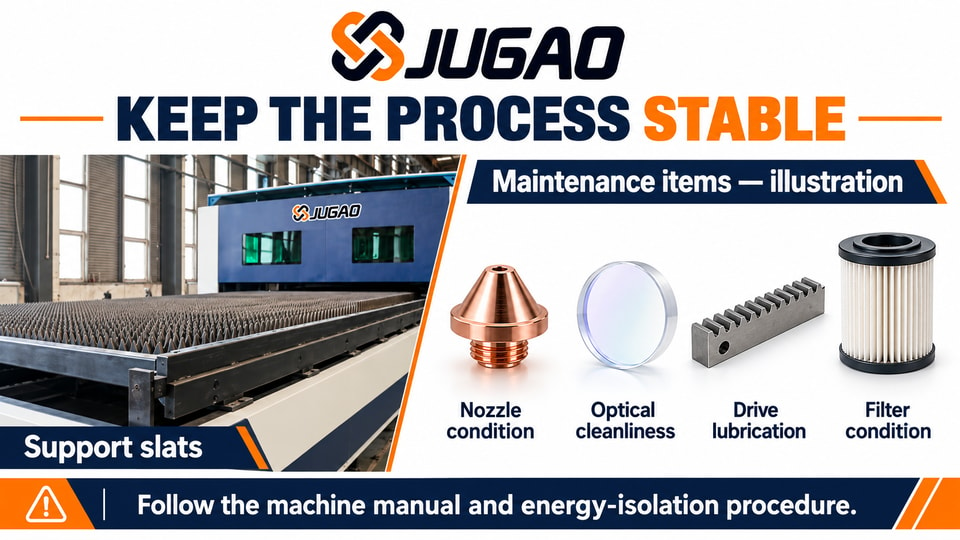
- Nozzles and protective optics: contamination, damage and approved handling.
- Support slats and slag collection: buildup, stability and safe cleaning.
- Motion system: lubrication and condition checks specified by the manufacturer.
- Extraction and chiller: filter condition, coolant condition and operating alarms.
Turn disclosure into an acceptance plan
Competitor documents show useful specification fields to request, rather than values to copy into a JUGAO offer. Bystronic separates nominal size, actual cutting range, load and exchange time; TRUMPF explains external pallet handling and guarding; HSG distinguishes individual models; AMADA describes additional loading automation. Use those distinctions in the signed configuration and FAT/SAT plan. As a practical starting proposal, test 3–5 representative part families and record at least 10 cycles under agreed conditions; this is a suggested sampling plan, not a prescribed standard.
| Competitor disclosure example | Question for JUGAO |
|---|---|
| ByCut 3015: 28 s exchange; 1550 kg workpiece; 3100 kg two-table total | What are your exact time boundaries and each-table/combined load limits? |
| ByCut 3015: 3000 × 1500 mm nominal; 3126 × 1600 mm cutting range | What are nominal sheet size, cutting envelope and axis strokes separately? |
| TRUMPF pallet changer / HSG GX / AMADA automation | Which handling, safeguarding and automation functions are included in this order? |
Blank FAT / SAT record
| Field | Record |
|---|---|
| Part / drawing / program revision | ________________________ |
| Material grade / batch / thickness / gas settings | ________________________ |
| C / H / X for every cycle, s | ________________________ |
| Median / slowest cycle / exceptions | ________________________ |
| Dimensions / edge results / accepted quantity | ________________________ |
| Safety test record / responsible person | ________________________ |
| Open action / owner / due date | ________________________ |
Frequently asked questions
When does an exchange table help?
When external handling can safely overlap with cutting and the saved waiting time exceeds the complete exchange overhead. Measure C, H and X on representative jobs and check accepted parts per shift, including downstream bottlenecks.
Does an enclosure mean Class 1?
No. Classification requires evidence for the installed system and its accessible radiation under defined conditions. Verify the wavelength, power, protective enclosure, viewing windows and interlocked access against the machine documentation.
Does 3015 describe the machine footprint?
No. Request the installed-cell drawing with pallet movement, service access, material handling, extraction and chiller space. Nominal sheet format is only one input to the layout.
Can 2 kW cut my target thickness?
Confirm it through a representative material trial with agreed edge and dimensional criteria. A public speed chart does not define every alloy, surface, gas, nozzle, piercing strategy or production-quality limit.
Do axis accuracy numbers equal part tolerance?
No. Axis test results and finished-part measurements are separate acceptance items. Heat, process settings, work support, kerf and inspection method also influence the part.
How should I choose air, O₂ or N₂?
Define material and downstream edge requirements first. Then trial the appropriate process while confirming pressure under load, flow, purity and moisture/oil control. Compare acceptable parts and necessary rework.
Is automatic exchange unattended production?
No. Sheet storage, loading, unloading, sorting, guarding, alarm recovery and staffing are separate systems or operating arrangements. State the required level of automation explicitly in the inquiry.
What files should I request before acceptance?
Request the signed configuration, general arrangement, load and cycle definitions, sample-cut records, laser classification evidence, risk assessment, safety-function validation, manuals and FAT/SAT records for the supplied machine.
Bring your parts to the configuration discussion
Start with the JUGAO ER3015-2000W reference page, then send the information that determines the complete enclosed exchange-table cell: material grades and thickness distribution, representative drawings, required edges, output target, staffing, available services and factory layout. Ask for a configuration sheet, arrangement drawing, load/cycle definitions and a sample-cut acceptance plan. This connects the machine choice to verifiable production requirements.
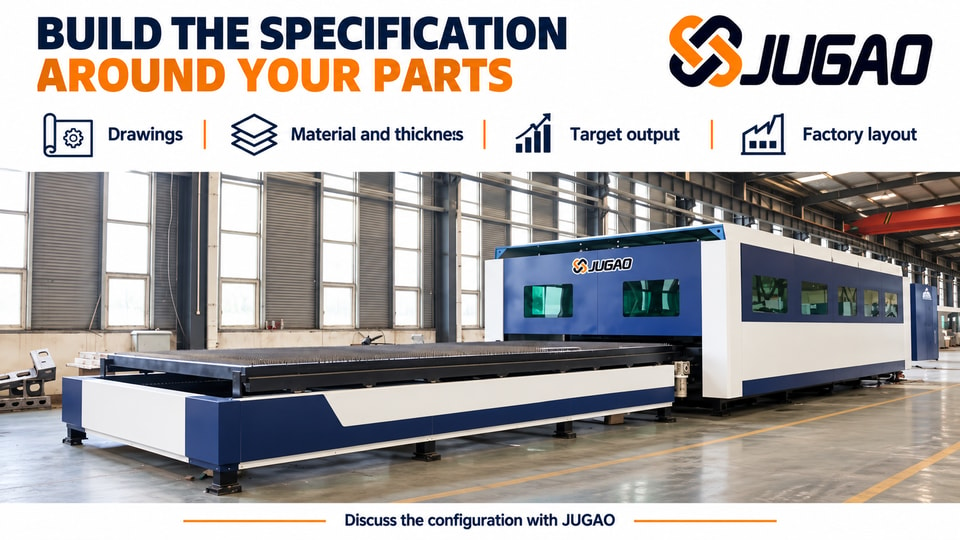
- Drawings and tolerances; material/grade/thickness and sheet dimensions.
- Target accepted parts or sheets per shift; handling and downstream assumptions.
- Power, gas, cooling, extraction and site-layout information.
- Required safety documentation, training, spares and FAT/SAT criteria.
Sources and technical references
- JUGAO ER3015-2000W specifications
- ISO 11553-1:2020
- IEC 60825-1:2014
- IEC 60825-4:2022
- ISO 14119:2024
- ISO 13849-1:2023
- OSHA 1910.212 — machine guarding
- OSHA 1910.147 — hazardous energy
- OSHA laser technical manual
- HSE — cutting metals
- ISO 230-2:2014
- ISO 9013:2017
- TRUMPF — flame cutting
- TRUMPF — fusion cutting
- Bystronic ByCut technical specifications
- TRUMPF — pallet changer and product enhancements
- HSG GX series
- AMADA AMS 3015 CL(T)
Contact Us